Streaming Discovery, Public Nuisance and TikTok Shop | The Media Beat #101
[00:00:00] Oliver
Hello everyone and welcome to the Media Beat episode 101. We are now into, well into, our second century of podcasting and thank you for staying with us.
[00:00:21] Oliver
Our audience is steadily growing all over the world and it's great to Have you? Every time. It's the Media Beat with Claire and Maureen, or Maureen and Claire. And as usual, we'll be doing a deep dive, having some news and having some Podmoji today. There's some interesting stuff. That we found as well. Meta has been fined Sony is making a major change to the PlayStation. We'll talk about jukebox musicals we'll talk about ai slop of course you can't avoid it and something called which i sort of understand the gen alpha melody stay tuned although of course we don't tune things anymore But stay listening. The first bit of the show as usual is a deep dive very interesting one so this is another one that we've touched on briefly over the years And it's about searchability — how people find they're looking for, and crucially as Claire says, how platforms try to guess you want to see before you know that you want to see it. And that is a perennial problem with the digital streaming world. And Claire and Maureen are going to take you through a little bit of it. Claire's going to start. So I guess the history was a lot more simple than it is these days. But just take us through how this has become one of the biggest challenges for creators and broadcasters.
[00:01:45] Claire
I will. But before that, I have to say, for those of you listening rather than watching us, this is a summer special episode. Both Maureen and I are in different locations than usual, partly to escape the heat. And Oliver has the most amazing shirt on. And you're going to have to go on our YouTube channel just to see the shirts, I think, because Maureen and I are sort of speechless.
[00:01:59] Oliver
You're very kind.
[00:02:07] Claire
I'm not sure we're going to be able to complete the deep dive, but it's beautiful and it suits him very well.
[00:02:14] Claire
Anyway, let's move on
[00:02:15] Oliver
Extremely kind.
[00:02:16] Claire
This deep dive, I'm going to be honest, is brought to you by my ongoing feud with an LLM — which I'm assuming is based in Utah for some reason — and the deceptively simple question of whether Sports Night, one of the series I really love, is on Netflix. Sports Night is not on Netflix. Apparently, the rights still haven't been sorted all these years on. And helpfully, when I pushed Netflix's own AI search on the subject, it decided I actually wanted to see was a documentary series about the World Series. I did not. Close but no cigar — and a fairly good illustration of where we've ended up, with streamers throwing newfangled interfaces at us, from AI search to vertical shorts to contextual recommendation.
[00:03:01] Claire
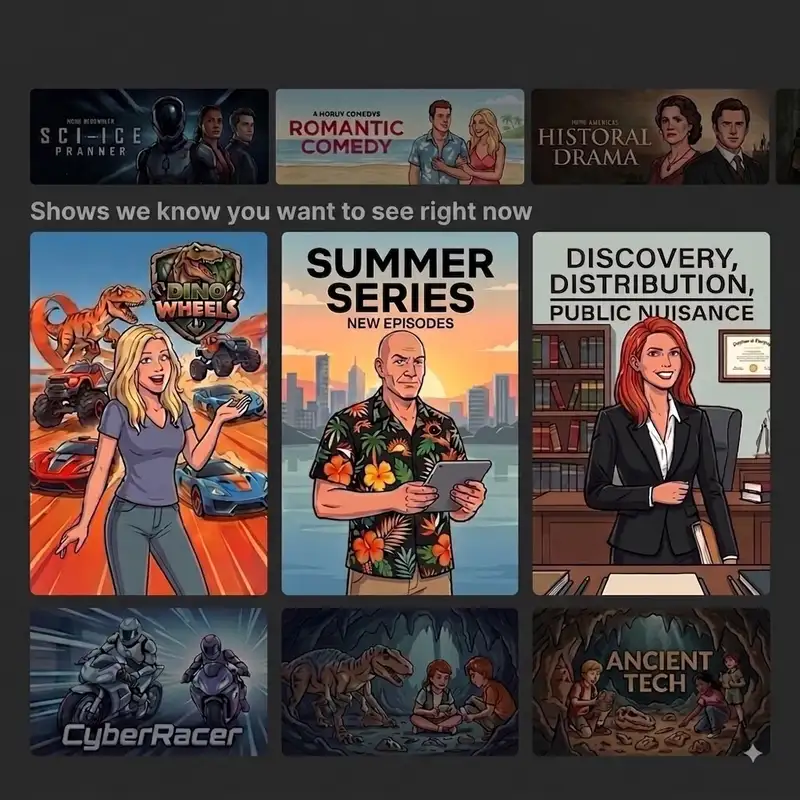
Hoping one of them will finally understand we're actually asking for. Maureen's going to go through some of these interface experiments in detail shortly, but I thought I would start by giving you a little bit of background. About how on earth we've got... Where we've got to. Streaming services started out fairly simple. With a fairly simple layout: featured programmes, continue watching, and basic search. Essentially, it was a digital TV guy blended with a blockbuster video shop experience minus the popcorn aisle. As technology, consumer behaviors, market competition evolved. So did the interface. First thing we were given were multiple user profiles, very handy for household, even handier for the algorithm, which suddenly has much cleaner, highly personalized data. In theory, at least. In practice, all it takes is one Five-minute lapse in vigilance, which happened to me earlier this summer. I recently let my seven-year-old nephew... Watch Hot Wheels on my Netflix profile for 20 minutes. My homepage was instantly misdirected. Years of carefully cultivated psychological profiling. Vanished. Overnight, suddenly, my top row was offering me Hot Wheels Let's Race, Neon Monster Trucks, and Talking Animated Tractors, because the algorithm doesn't oh, I have a nephew. It just assumes I'm having a massive personal breakdown and really, really need to see cars jumps through loops of fire. And this is really this fragile relationship between the user and the machine is where we are and is happening right now. We are. Exhausted. By these interfaces. According to data from Nielsen, the average viewer now spends 10 minutes just strolling through tiles trying to pick something to watch. That's up by more than 40 % compared to a few years ago. And here's the stats that really shows how badly these interfaces can fail. 20 % of viewers, one in five browsing sessions and with the person giving up and doing something else entirely instead of watching. In the UK, a recent survey from EETV found that the average Brit spends 28 hours a year searching for something to watch. And nearly half of us, 45%, admit we regularly give up and re-watch an old comfort show we've seen 10 times already. Purely to avoid. Decision fatigue. Well, that's a bit of a disaster for streamers and they are desperate to fix this. Why? Because as we've discussed before, the cost of churn is genuinely terrifying to their business. In any subscription economy, the rule of thumb is that acquiring a new customer costs around five times more than keeping an existing one. So if a platform loses 4 % or 5 % of its user base each month to churn, it has to spend hundreds of millions of pounds on marketing. Off platform just to stay in the same spot so the interface is literally the last line of defense against you clicking cancel To stop you from canceling, platforms run relentless A-B testing on us. So you know A-B testing is? this Two very similar profiles will get a slightly different experience and then they will measure which one works better. Millions of us are at any moment part of an invisible experiments testing layouts, trailer length, and thumbnail designs. Now, an old piece of research by Netflix has shown that users spend an average of 1.8 seconds. Considering each title as they scroll. 1.8 seconds. That's less time than it took me to actually say this sentence. And 80 % of that focus is on the image rather than the text. So if a new thumbnail generates you know a double-digit bump in viewers, that artwork becomes the new global default, and none of us ever find out it happened. The end. They will also adapt the experience depending on device you're using on smart TV, which is still, you know, it is now about 60 % of all streaming watch time. The interface is built for lean back, high impact visual. On mobile, where attention spans are shorter, it's much more like social media, as Maureen will discuss, leaning heavily into vertical video feeds and quick share tools. The hybrid testing is also how, I don't know if you've actually looked at the categories on your Netflix feeds recently, but we are getting into seriously, increasingly unhinged, ultra-specific role titles. So there's one that's called Shortass Movies. This is a real one. Netflix created that after a Saturday Night Live skit went viral. There's one called... Swipe Left, which is dedicated exclusively to disastrous romance stories. And then there's one that I noticed recently when I logged in, which is called Erase My Memory So I Can Watch Again. Which is another way of saying you've seen this already. But it also speaks to me on a spiritual level. And... It does work. Netflix states that over 80 % of all viewing across the platform is driven directly by these algorithmic recommendations, which is why I've started watching Hot Wheels. Obviously nobody's searching for anything anymore. We're just being served content. So The whole... The ecosystem is now entirely designed around lowest possible friction. They don't want you to feel any pain at any time in the process of trying to find something to watch. So they've redesigned interfaces, especially on mobile, to... Make it look like Instagram because they know that people like Instagram and they spend time on Instagram. So we're going into a vertical short form world or TikTok, full screen autoplaying, vertical feeds, and then this famous AI powered search that is now available on Netflix on mobile platforms, which is really meant to... It's been built to interpret very vague natural language queries like... Show me something upbeat with a 90s aesthetic. For mood-based browsing, it's really good. But if you're looking for a specific show, like, say, sports nights, then you know that doesn't work at all. And so they've lost something in the bureau the purity of the search. Obviously, in this in this experiment. Natural language search is much better at vibes than facts, as we all know. So. That's my very brief background on how we've ended up where we are and why I'm really frustrated that I still can't watch Sports Night. But I'm going to hand over to Maureen now to go through some of the new technologies that is being developed.
[00:09:29] Maureen
But those stats were amazing. But yeah and Quite good. Sorry to say quite comical, but... And Anyway, I mean, you've brought us here very quickly, which is really interesting. Under a different category which is Claire's very... Comical way. Of being upset. But not – but grinning at the same time. So anyway, so everything I'm going to – has happened not over decades but over 14. 14 or 15 actually probably now weeks. And I'm going to talk specifically about some of the major players that are upsetting Claire. But But I'm going to talk specifically about how...
[00:10:13] Claire
I'm just too old for this shit.
[00:10:15] Maureen
And you No, you're not. No, you're not. No And you'll see why in i mean in about five minutes.
[00:10:19] Maureen
You'll see why. I'm going to talk about some of the major players. They really have tried their best, Claire. Just hold on. So, OK. So, in In April, Netflix launched its redesigned mobile app in nine countries. We included in that UK or France. I think France was included, built around a vertical, as Claire's been alluding to, vertical feed called clips. And a lot of people are accessing that. Specifically on their mobile phones. In late July, HBO Max launched two things on the same day: a vertical clip feed and a conversational search tool called Ask. Straightforward: Ask HBO Max.
[00:11:16] Claire
I mean, we all know HBO Max is very good at naming stuff, so yeah.
[00:11:18] Maureen
We know their naming track record — it's either HBO or Max or Max Redux or back to HBO again. So and then And then on the 5th of August, following the Disney results, they put natural language search. Into beta into a beta version of Disney Plus and yeah ESPN. So in late July, we also had Reuters. Reporting that Jeff Bezos had personally directed a prime video redesign internally called Lighthouse, of course. It's called Lighthouse, a Lighthouse project. I think oliver will know about these because every single consultancy every project will have Where's your moat or where's your lighthouse project and that was built around ai recommendations so Clare. Oliver that's full companies in one quarter, And the two and probably. Probably two features which were the same. But actually they do. ! she could This is my sigh of relief, but also for Claire. They do different jobs. So the vertical feed guesses before you ask. Conversational search waits for you to ask. But let lets you do it in normal language instead of typing a title. So one removes the question and the others removes the keyboard. And the major streamers are building both, much to the upset of Claire. So anyway, so Warner has been very open about. How it feeds, its own feed works. And they have an in-house model that reads scene. Level metadata to identify moments likely to hold attention. So human editors are actually In the loop here, they choose the final clips and they reframe them. Vertically so there's definitely a lot of work that's going behind the scenes so this is editorial work as much as it is engineering. A catalogue that used to be indexed by title now has to be indexed by moment. And the libraries built for a search box are being built around Mood. Scene and tone. And that change is exactly 's being surfaced to you. So a show that worked under thumbnails and rows may not work now. When somebody simply types. I want a dysfunctional family drama please it's not going to come up with anything I want to know.
[00:14:04] Claire
How did you guess my search?
[00:14:04] Maureen
Wha- I peered over your shoulder one day.
[00:14:10] Claire
Yeah Oh yeah.
[00:14:10] Maureen
Yeah yeah so So the system is reading. Different signals we've got completion rates we've got scene level tagging so you know so how closely a show maps in natural in the language somebody uses you know in a prompt The licensing deals across the industry were negotiated around the old discovery system. So they assume people would browse by rows, by titles and pick one. That assumption no longer holds. And I haven't seen any evidence the licensing terms are being renegotiated to reflect it. I haven't seen any evidence that... The licensing terms are being renegotiated with it in order to deal with how we would like naturally. Either guessing or not guessing, to find a particular program. There's also an advertising question. Changing how people find something to watch does not create more impressions — it changes which titles those impressions run against. So if a mood prompt sends viewers into different parts of the catalogue, then than the old sort of recommendation engine the inventory changes with that And with them so show level and genre level targeting in connected tv relies on fairly predictable content adjacency. A mood led prompt may not deliver that. None of these companies have published a comparison of outcomes. The advertising is still being sold against assumptions built around the old system. So so two things from this week, I think, which makes the change a bit clearer is. Disney's feature is called Personal Intelligence. It connects a subscriber's Gmail and Google Calendar To answer the questions in context. So if they believe that we've had so many meetings or we've had so much fun, you know they'll be able to predict the mood and the context of which the sort of programs you want to watch.
[00:16:35] Claire
As- Terrifying!
[00:16:36] Maureen
Hup! I... I don't... It's opt-in and off by default. There's a privacy trade-off and it will be argued over. But it also changes discovery is. It's no longer about sits inside the catalogue — it can respond to is happening in your week. Okay, so that's the first thing. The second thing came on the 5th of August, around the Disney results. The day before its own AI search announcement, Disney signed a short-form deal with TikTok. As we know, and I think we're sort of, yeah.
[00:17:21] Maureen
So opt-in. Is Again. Opt-in creators and so the creators videos will appear inside Disney's own vertical. Feed vertical program i'm going to call it which is called verts the vertical feed discovery stuff but it reminds me of green i keep when i when i look at you claire i think of there is a green you know but and So the vertical feed of a naming issue, the vertical feed that Disney started. Rolling out actually in march but now they've realized it in terms of signing and an agreement with With TikTok. I've tried to find out the deal terms are, who owns the IP, they can and can't do — but neither Disney nor TikTok will answer those questions. But anyway disney as we know has a century of its own library but it's still bringing content in. Into its service from a platform competing for the same attention. The idea is to bring a TikTok creator into your ecosystem because they're already performing well with their followers outside it. So anyway, so these systems are being sold as easier ways to find something to watch. Clare. Little do you know that that they are working on this.
[00:18:47] Claire
No but I knew I wanted to watch this is my problem
[00:18:50] Maureen
I know! there this There is a real problem to solve there.
[00:18:54] Maureen
There is.
[00:18:55] Maureen
There is But when a system guesses you want, it's also making an editorial choice for you.
[00:19:00] Maureen
Something decides appears and something decides does not. When a row said "comedy" or "documentary" you could see the organising logic. But when the category becomes a mood generated around you, that logic is harder to see. So accuracy is only part of this. Accountability, of course, is going to be the rest. Who is responsible for gets surfaced? I don't know, but they've got to So the moral of the story is they've somehow got to fix the old legacy systems and match that with not only... Advertisers and brands are looking for, but also people actually want to watch and how they want to watch it and how they want to ask. For it. Or Be kind of like you know hinted at or nudged or prompted of they would like to watch so we have no answers to this but it was comical to go through it I think
[00:19:56] Oliver
It was wonderful to watch Claire get more and more frustrated.
[00:19:59] Maureen
She go instantin she I can see the steam.
[00:19:59] Claire
Well before Before we close this topic.
[00:19:59] Oliver
What was
[00:20:01] Maureen
I can see the steam. Yeah.
[00:20:02] Claire
I'm going to make an appeal to our listeners.
[00:20:05] Claire
If somebody is working right now at Netflix, listening to us. I don't need to be served more Hot Wheels content until my nephew comes back, which will not happen for a few months. I'm okay. Thank you very much. Secondly, could somebody please clear the rights to Sports Night so I can watch it again? It was Aaron Sorkin's very first series. It ran for two seasons. It's absolutely brilliant and it's not available. Anywhere. So these are my two pleas.
[00:20:32] Oliver
Yeah, well, let's use our audience. And that's right.
[00:20:34] Oliver
The Venn diagram between senior executive French ladies and monster truck rallies is a very small overlap. That's all I can say. How a fascinating.
[00:20:43] Claire
Somebody. Small seven-year-old boy.
[00:20:45] Oliver
Yeah, maybe slightly more. He's absolutely messed up your algorithm.
[00:20:47] Maureen
Yeah, exactly.
[00:20:49] Oliver
What a fascinating subject. And I love the way we can go the history. Very simple history from when it was very simple to now the ridiculous complex complexity of it in such a small space of time you both did a fabulous job there i was absolutely hooked thank you i didn't even know a mood led prompt was and now i do i will be using that at dinner tonight But unfortunately, we have to move on. As always, anyone who can help fix Claire's algo, let us know. But for now, we have to move to In The News. Massive business fine news coming in. One billion dollars. I've got to say that without saying it in the Dr. Evil voice. Meta are on the receiving end of that. Maureen at Meta head office. You have that story, Maureen.
[00:21:41] Maureen
It's actually just below one billion dollars.
[00:21:44] Oliver
Yeah. Okay, so not so bad.
[00:21:49] Maureen
But I'm sure that we could figure out some sort of currencies and curry. Conversion to make it a billion, but i I'm afraid it's just...
[00:21:57] Maureen
A judge in New Mexico ordered Meta to pay $560 million, and a jury added a further $375 million in March, taking the total to $942 million. Shy of a billion, but the number isn't the best part. The legal basis is.
[00:22:40] Oliver
9.30 from now.
[00:22:44] Maureen
That's not. I mean it got the attention but that's not the best bit. The best bit is the legal bit as always so the legal basis is the most important part here so The judge found that Meta had created a public nuisance.
[00:23:02] Maureen
Which is Wonderful, wonderful. So 420 million. Of this particular award. Or Fine. Will be awarded as part of 's called an abatement fund for treatment services for young people. Over the next five years. The money is redirected to help those who suffered the nuisance. This is not a privacy fine. It's not a competition fine. It's a public health remedy with money directed towards the harm the court says was caused. So that legal approach has been used in tobacco many years ago and opioid cases as well. So now it's being applied. To social feed so meta says of course it disagrees it will appeal It's also disclosed in its latest two quarter second quarter. Results around 2.4 billion. This is the billion mark here, to in charges tied to legal proceedings. In this year in 2026 This single award is not the main point. It's the precedent. So public nuisance cases do not necessarily require a legislature. To pass a new platform law. Which is something that's going on in the UK at the moment. So it requires a court to simply find and that the design of a product. Amounts to a nuisance. The court has now done that. Extraordinary in terms of a legal finding.
[00:25:16] Maureen
Claire, did you think?
[00:25:17] Claire
The judge specifically made the analogy to factory and pollution — Meta's platforms were the factory, And the features where web the factory produces and the resulting harm represent the pollution. And therefore it needs debated. It opens the door to any legislature anywhere in the US to make similar claims. It's a real problem for Meta and they will appeal. As part of the judgment, in addition, this is my only point because you've explained it so well, but in addition to the fine, The court-mandated pretty sweeping operational changes across all of the meta-platforms, which remember is Facebook, Instagram, and WhatsApp. Amongst a few others. For instance, usage and time for teenage users, usage and time capping, notification silencings during... Night hours and during academic school hours on weekdays. Defaults for privacy and visibility communication restrictions reporting etc so they In addition to the fine, they if they have to comply by the ruling, they will have to make some... Pretty significant changes to their platform so a fascinating ruling and i'm looking forward to seeing where it ends but i agree with you i think it's a it's a good thing
[00:26:47] Oliver
Yeah, that's absolutely brilliant. Getting them to pay for the nuisance they've caused. Excellent. And you're right, Claire, that was beautifully explained. Thanks, Maureen. What a great story. Worth the trip to Metis HQ for you to laugh at them. So when I was a young lad and I started in the computer business, we used to use stuff called half inch analog magnetic. Tape to do our backups for the factory in which I worked.
[00:27:11] Oliver
Physical media has been phased out slowly over the years — and now another one bites the dust. You have that story.
[00:27:24] Claire
That is correct. Sony has announced that PlayStation would phase out physical gaming discs. Starting in January 2028, so not quite now, and probably coinciding with the release of the new PlayStation, by the way, which may well not have an optical disk drive. So that's probably why they're doing this. That they There's loads of reasons. Sony obviously talks about consumer behavior as the primary driver and digital purchases currently account for 80 % of software sales on the PlayStation platform. So there is a point there. But Also... It costs much less money you're elim eliminating overheads you're ending second-hand sales which you know People like Sony gaing gaming companies do not like secondhand sales and you control the price much more than when it goes into shops, which may decide to. You know do their own discounts and you've got massive technical logistics that you don't need to deal with anymore. There are lots of good commercial reasons beyond consumer behaviour. There are some consequences worth noting. The first is the impact on high street retailers. There are a few high street retailers still around. There is There's quite a big retail market for pre-owned games markets. That's going to go now. Bricks and mortar stores will need to rely on... Retailers will have to rely on hardware and accessories. It will be a significant hit. Market pricing will be far easier for Sony if they go fully digital. But I thought this was also interesting. Industry archivists have expressed concern regarding historical preservations. Obviously, physical copies serve as historical artifacts, but now with an old digital ecosystem, there will you know an old title will only remain available if the publishers decide to maintain download servers for these titles, or it could just disappear forever.
[00:29:32] Claire
A significant moment in the history of gaming and media generally.
[00:29:43] Maureen
The archivist that's that's and preservation, that's fascinating, actually.
[00:29:47] Maureen
Keep 70 million in mind — that's roughly how many PlayStation game discs were still sold last year. Out of the 318 million game units in total. And that downloads were about 85%. So there's still demand for discs. Sony has i think decided digital store clearly is better for the reasons that you've set out, Claire. The disc though announcement came, I think, with something else, the closure of PlayStation Store on PS3 and Vita. So that changes access to things people have already paid for. The disc was never really the product, I think — the licence was. The disc just made that licence feel like something you owned. And there's a lot of people who still love. That sort of physical copy to say I've got something.
[00:30:44] Maureen
You know and
[00:30:45] Claire
Which I can sell.
[00:30:47] Maureen
I recall when I was doing some work in the music industry, looking at Spotify subscriptions: the Japanese and German markets in particular, even though they had digital versions, specifically wanted the vinyl or the CD copy even though they didn't have a player for it. They wanted it as memorabilia.
[00:31:21] Maureen
As well. So it's fascinating, yeah.
[00:31:22] Oliver
Absolutely. Yeah, wow.
[00:31:24] Maureen
Interesting choice of business decision. Yeah.
[00:31:27] Oliver
I just took a trip down memory lane to see those old tapes and there was like about three quarters of a kilometer of magnetic tapes in those things which I used to use to do easily new backups. Happy days. Happy physical days. So that was a great story. And we've got a final story. Oh, yes, yes, yes, yes. We talked about this before as well. But Maureen, you say it is worth talking about as a new story of the explosion in social media retail. What's happening out there?
[00:31:58] Maureen
Today's show is all about billions.
[00:32:02] Oliver
Lovely numbers.
[00:32:02] Maureen
Yeah, yeah. So so here's a number for you, Oliver. TikTok Shop moved an estimated $50 billion of goods worldwide in the first half of this year — up 92%.
[00:32:16] Oliver
Wow.
[00:32:20] Maureen
So those. 92 % extraordinary. Those numbers come from Momentum Works and Tabcut. Not tick tock itself so So if anyone's out there. Just checking our numbers. I'll get the number i get the name right. Nick Nino, if you want to check it.
[00:32:39] Oliver
Oh yeah.
[00:32:40] Oliver
He was very good about it.
[00:32:41] Maureen
If you're checking my numbers, I still have to, I still think about him as called Nico. Nino, if you're checking our numbers, as I say, they are momentum works and tab cuts. So I would treat the precision carefully there. The US accounted for $11 billion, moving back ahead of Indonesia. The people buying have changed too. Last year, video drove about 50% of attributed sales and the Shop tab The TikTok drove about 36%. That was last year. This year it's flipped. The shop. Tab. Is now just over 50 % while video is 40 % and live.
[00:33:27] Maureen
Is down. To 8%. So. Amazing. So TikTok shop was built around discovery commerce. People saw something and they and they bought it even though they weren't looking for it. So now more people appear to be entering tickkok TikTok shop. Intending to buy and then searching In the same week, YouTube opened its shopping affiliate programme for UK creators with six named retailers and a threshold of 500 subscribers. The products may look similar on screen but the transaction is not. On TikTok, the purchase happens inside the app. On YouTube, the viewer leaves and goes to the retailer's website. TikTok owns the checkout; YouTube sends the customer elsewhere. The company handling the payment also sees the purchase data. Right now, that is TikTok. Within a year it has flipped — people now go specifically to the Shop tab to purchase rather than stumbling into it while browsing. Claire.
[00:34:47] Claire
I doubt There's nothing very specific that I can add to this because that was beautiful. I'm going to give you some interesting random facts because I know you love them. Apparently, this is quite an old stat, but it's still it's still quite funny. About 50% of mobile ad clicks are accidental — it's called the fat finger economy.
[00:35:07] Claire
People click by accident. And one of the things that a lot of these online shops and social retail medias try to do is su is to convert as many of these fat finger accidents as possible. So make it as frictionless as possible once you've accidentally... Clicked on something secondly this is also a slightly older stat but i love it too much to not put it up there If you find yourself making impulsive or erratic purchases, try putting on a pair of high heels, Oliver. A study from bri Brigham Young University revealed that consumers who are actively trying to maintain their physical balance, like wearing high heels or standing on one foot, make more balanced, rational buying decisions. Shut
[00:35:52] Oliver
Well, that makes sense.
[00:35:54] Claire
A useful thing to know.
[00:35:54] Oliver
Yeah, well, I don't need an excuse. I don't need an excuse to put my high heels on.
[00:35:59] Claire
Next time you're scrolling TikTok Shop and you really want to buy something — try standing on one foot first.
[00:36:11] Oliver
What a good idea.
[00:36:12] Claire
There you go.
[00:36:14] Oliver
Yeah, you're right. Morning's on fire today with regards, very clinical explanations out of things. And that was absolutely fascinating. So I understand why that's a new story. Things change so fast. Imagine being an executive in one of those companies. It must be like, oh my God, 's happened today that we've got to react to and build on. But anyway, good luck to them. I must go on to TikTok now on one leg and make sure I don't buy anything. But that for now. Was in the news. Which means that it's time for Podmoji and I'm looking forward to some very, very interesting props. That might be used but The first one we're going to talk about, and this is it's going to go to you, Claire, first. Oh, these jukebox musicals, yeah. Yeah How far are they going to go? They're going to go, yeah I don't know, all the way down to, I can't think of an obscure band from the 80s. The Smiths. Well, they're not obscure, obviously, but that would be a great one. A great jukebox musical. Actually, that would be a really good idea. Anyway, jukebox musicals. Claire, 's up?
[00:37:17] Claire
More and more of them. We keep coming back to the discovery problem — it's true of everything. It is harder and harder to launch anything new — true in movies, TV, and now theatre. If you're launching something new, you use existing IP — whether it's a film like Devil Wears Prada, now a live show, Or they call jukebox musicals. Now the original Not the original, because it's it's obviously it happened before, but the most recent huge success. In terms of jukebox musical, was obviously Mamma Mia, which, you know, ended up grossing $4 billion dollars worldwide, was seen by over 65 million people around 50 countries, and, you know, obviously spun two movies, and is continue is still running in the Western after more than 25 years. We've had Jersey Boys, we've had Moulin Rouge, the musical, we have We Will Rock You, and I guess you can discuss you can guess which... Which music is featured in that. Two new ones: TLC's Crazy, Sexy, Cool — getting decent reviews, just opened in Washington ahead of a possible Broadway run. But, you know, that's the truth.
[00:38:41] Oliver
They weren't around that long, were they?
[00:38:43] Claire
They were not around that long because one of them died, Lisa Left Eye Lopez.
[00:38:48] Claire
And they do have some good songs. But anyway, that's the new one.
[00:38:52] Claire
And A Beautiful Noise, the Neil Diamond musical — which has also just opened in Melbourne.
[00:39:05] Claire
And apparently a Huey Lewis and the News musical too.
[00:39:08] Oliver
All right you need to
[00:39:12] Claire
They are going to keep coming. I feel quite sad in some ways because it's not the most creative approach — but in other ways, I think it's good that people are still going to see live shows. So I'm ambivalent. So Little Fox is not sure.
[00:39:35] Oliver
I mean... That's right. Fox is... Fox is renowned for sitting on the fence, I suppose.
[00:39:40] Claire
He's sitting on the fence.
[00:39:40] Maureen
Thank you Oliver.
[00:39:42] Claire
He's not sure.
[00:39:43] Maureen
I didn't know that meant, yes.
[00:39:45] Oliver
Fair enough. Fair enough. Not that you've got to.
[00:39:48] Maureen
Oh gosh!
[00:39:49] Oliver
Furry fox to hand Yeah. Why does that sound rude?
[00:39:53] Claire
He's a car fox.
[00:39:53] Oliver
I don't know. It's very cool.
[00:39:54] Maureen
Need as
[00:39:55] Oliver
Morning.
[00:39:56] Maureen
There we go car fox is that of course of course you know of course oliver we should have known that we should have known that Huh?
[00:40:01] Oliver
Indeed, indeed
[00:40:03] Maureen
How on earth do I follow that? so So this effectively is a catalogue business, though, isn't it? A rights holder gets another way, to some extent, to monetise existing catalogue without paying to make another. New recording so there's but in this instance there's a ticket price attached so potentially a touring life after the original production too. Great. And I think the demand is there. A Beautiful Noise opened in Melbourne last week as well.
[00:40:37] Claire
Yeah. Yeah.
[00:40:40] Maureen
So so
[00:40:41] Claire
They travel.
[00:40:42] Maureen
You know, you said. They travel as well, see?
[00:40:44] Maureen
They travel. And the TLC one is testing in an arena in Washington.
[00:40:52] Maureen
So i mean of all the places so i think i think the catalog is no longer just you know like so it's been licensed as recorded music so it can become a live show too so it is just another form of exploitation. Where there is a where there's an audience. David Byrne's Talking Heads production was theatre — but COVID hit and it ended up on Netflix. I think that would have been travelling material.
[00:41:30] Oliver
But he's he's touring again, David Byrne, with the show, the Australian theatres.
[00:41:31] Maureen
But yeah. Hey. Is he starting again?
[00:41:34] Oliver
And we I went to see it. Yeah.
[00:41:35] Maureen
Okay, brilliant.
[00:41:35] Oliver
And it was magnificent.
[00:41:38] Oliver
I love talking heads.
[00:41:38] Maureen
Male Speaker 1
[00:41:39] Oliver
But this, absolutely, because of the visuals and everything and the weirdness.
[00:41:43] Oliver
Trumped I thought.
[00:41:43] Maureen
The weirdness of it, yeah.
[00:41:44] Oliver
It's absolutely brilliant. That's my that's my tip. David Byrne, if you get to see him. Great.
[00:41:49] Maureen
I endorse that as well. Big thumb up. But Claire wants to say something.
[00:41:51] Claire
That's your foot emoji. I just wanted, I just got to go back to the TLC one because I i should have said it.
[00:41:53] Maureen
That's my thing.
[00:41:58] Claire
I wanted to give a shout out. It's being directed by Kwame Kwe Alma, who's a Brit. It's an OB, actually, and used to direct the Young Vic. It's a pretty... Big theater director and playwright in the UK. So he's obviously decided to go to Washington too.
[00:42:13] Oliver
Good for him.
[00:42:14] Claire
Direct this new musical.
[00:42:15] Oliver
Pick up the Brit. Well played. Okay. Kind the Very few...
[00:42:18] Maureen
Super. And UK talent as well.
[00:42:19] Oliver
Cog I can't believe I'm listening to the news. It's scraping around.
[00:42:22] Oliver
Foe What's it called?
[00:42:23] Maureen
You stupid!
[00:42:23] Claire
Can't wait for that one
[00:42:23] Oliver
Is it called...
[00:42:24] Maureen
You still can't get over that one, can you?
[00:42:25] Oliver
The power of Kiwi Lewis in the news.
[00:42:26] Maureen
I can see you're frowning.
[00:42:27] Claire
The power of love.
[00:42:27] Oliver
Is that quote
[00:42:29] Claire
Oh gosh.
[00:42:29] Oliver
There's a movie the power of how he leads in the news that's terrible anyway i mean Not disagreeable as a musical act, but anyway.
[00:42:30] Maureen
That is extraordinary.
[00:42:35] Oliver
Okay, cool. So there we are. That was good. We've got a thumbs up for Fox. Nicely Okay, next one. All right, we so we talked about AI slop. We talked about ai slot particularly on linkedin actually but There is an AI slot filter, apparently, Maureen. What's... What's 's your view on that how good is it in Podmoji
[00:42:55] Maureen
LinkedIn has added a button that lets users flag a post as — and I'm quoting the label — "seems like AI slop." So flag flagged posts.
[00:43:14] Maureen
Guess Let's reach. So they basically will stop the distribution of that particular post. Not quite sure the mechanics behind the scenes, but they say that's they'll do. So the author gets a private message. Private message saying, Oops! the writing is coming across as Inauthentic.
[00:43:34] Maureen
According to LinkedIn, inauthentic.
[00:43:35] Oliver
Sounds good.
[00:43:37] Maureen
At the same time, LinkedIn is removing its own AI rewriting tool.
[00:43:48] Oliver
Yes that's right
[00:43:49] Maureen
So I don't know they're going to do with that bit. Is that Are they taking that away as well? Or are they going to actually... Tell themselves off. So anyway, it's it's it's replacing it with a proofreader designed to preserve more of the original voice. So So there will still be a button that says, would you like to proofread this? So so LinkedIn is now reducing the reach.
[00:44:07] Oliver
I suppose that's okay.
[00:44:10] Maureen
Of a style of writing. Its own tools helped make easier to produce. One detection company, Pangram, estimates that more than 40% of long-form posts on LinkedIn are fully machine-written.
[00:44:33] Maureen
Extraordinary — though this is one model estimating the output of others, so treat the precision carefully.
[00:44:40] Oliver
And that's their job, yeah. Yeah. Yeah. Yeah
[00:44:46] Maureen
Pangram sells AI detection, so treat that number with caution. So this is this is the great this is the great news. So
[00:44:55] Oliver
And the problem age.
[00:44:56] Maureen
LinkedIn's in now.
[00:44:57] Maureen
And the Podmoji is, oh.
[00:44:59] Maureen
What a hot ticket!
[00:45:00] Oliver
Oh here we go.
[00:45:01] Maureen
What a hot day.
[00:45:01] Claire
Oh That's a nice one.
[00:45:02] Oliver
And I just.
[00:45:03] Maureen
What a hot ticket.
[00:45:04] Oliver
Looking out like Mary Antoinette herself.
[00:45:04] Maureen
I mean.
[00:45:06] Oliver
Yeah that was that was beautiful and lots of ai detected says ai detection company that's that's
[00:45:07] Claire
Yeah. LinkedIn is the platform with more AI slop than any other. This is my Podmoji — not impressed.
[00:45:19] Oliver
Here we go. Oh, it's back It's back. Yeah.
[00:45:22] Maureen
It's back
[00:45:25] Claire
I...
[00:45:25] Oliver
Oh, yeah really?
[00:45:26] Claire
Really? Really?
[00:45:28] Oliver
Roar.
[00:45:29] Oliver
Okay, good.
[00:45:29] Claire
I think they're right to do it — it's become so pervasive.
[00:45:35] Maureen
Is important.
[00:45:36] Claire
I don't buy the 40%. I think it's much more. Actually.
[00:45:40] Claire
I think that underestimates how much AI there is on LinkedIn.
[00:45:44] Claire
LinkedIn is walking up to the fight. It was destroying their platform. But yes, I'm going with the.
[00:45:52] Oliver
Nice one.
[00:45:53] Claire
Not sure.
[00:45:53] Oliver
And if you're interested in non-AI slop, I would look at our section on LinkedIn.
[00:45:57] Claire
Yes, of course
[00:45:57] Oliver
The media read and obviously on the writing that maureen does with her human intelligence
[00:45:58] Claire
The best one
[00:46:03] Oliver
High level thereof on Substack featuring our own Maureen Kerr who writes some fascinating stuff.
[00:46:06] Maureen
This is And Forbes. And hoops, yeah.
[00:46:11] Oliver
And for yeah of course, we always forget Forbes and you always remind us because that's an even more premier brand, isn't it?
[00:46:12] Maureen
I hope so. Forth
[00:46:16] Oliver
And and the New York Times. And The Economist. No, I don't know. Not yet, anyway. So that's good. Thank you. Great, Podmoji. And a surprise one from Maureen there who whipped out a fan without any warning. And finally in this section, Claire. We talked about Gen Alpha Melody before. I had a look and tried to sort of understand it. But I think it's probably down to you really to understand it, to explain it better.
[00:46:48] Claire
The term Gen Alpha Melody refers to a specific four-note melodic motif — I'm not going to try to sing it. You'll have to Google it. It was coined by Danish musicologist Carl E. Martin to describe a musical trope that appears in And an incredible amount number of songs around the world that specifically appeal to Gen Alpha. Apparently there was an equivalent for the Millennials that was called the Millennial Whoop. So you can look it up as well. But here's a few examples. APT from Rosie and Bruno Mars, Forever by Lewis Capaldi, One of Your Girls by Troye Sivan, Sophia by Claro, Reckless by Madison Beer. These are all... Examples of songs that I've never heard of, but that use the Gen Alpha melody there, obviously quite famous. Writers are increasingly using it deliberately because they know it appeals to Gen Alpha. This isn't new — Twist and Shout and La Bamba share a riff. What's interesting is that it's been recognised and defined. Good for Gen Alpha. They have a melody.
[00:48:32] Oliver
Is that a yay? Yep, good, I'll take a yay.
[00:48:34] Claire
Yay, that's mine.
[00:48:36] Oliver
Right that's fantastic Maureen over to you
[00:48:41] Maureen
It's very difficult today to follow Claire in this, in terms of in terms of it tend to follow after.
[00:48:44] Claire
Oh but
[00:48:47] Maureen
As opposed to follow in terms of understand.
[00:48:49] Maureen
The copyright line is the part worth watching. The Millennial Whoop was a vocal technique — techniques are not protectable. Carl Martin's argument is that this is a specific melodic phrase, which puts it in a different category. He traces the earliest use to Anastacia in 2004 and has suggested over $100 million
[00:49:26] Maureen
in theatrical royalties — his own calculation, not a legal claim. And if you apply that
[00:49:39] Maureen
To the generative music. These systems are being trained on in the last five years of POP. I mean, if a phrase is already common in that training material, it assistance me. Keep reproducing it instead of just letting it disappear. It's going to go on. Forever and ever and ever. The copyright line is worth watching.
[00:50:01] Oliver
That is interesting.
[00:50:01] Maureen
And i am i am i am my Am I, am I, am I, might as well put him on 5G.
[00:50:01] Oliver
Thing What's she going to produce now? It could be almost anything, although you're flapping around a little bit. Like you haven't got anything else.
[00:50:10] Maureen
Exactly. I'm right. My problem is, oh. Oh this is the eclipse
[00:50:14] Claire
Oh, the glasses.
[00:50:15] Claire
Oh, the eclipse.
[00:50:15] Maureen
Eclipse. The Eclipse.
[00:50:17] Claire
Big clips.
[00:50:17] Maureen
Two clips.
[00:50:18] Oliver
Absolutely no connection soever.
[00:50:18] Maureen
Eclipse. I had to get it in somewhere
[00:50:20] Oliver
Yeah, okay.
[00:50:20] Maureen
The eclipse He could eclipse all humanity with his lawsuits.
[00:50:25] Oliver
Yes, not at all convoluted.
[00:50:26] Maureen
Which is... It glitzed. Exactly.
[00:50:30] Oliver
That' Absolutely logical.
[00:50:31] Maureen
I was struggling with that one to get a promotion.
[00:50:32] Oliver
And the fox comes back. Claire wants a few more points.
[00:50:34] Oliver
The fox is not getting any. Eat She's getting 5,000 points for the Fox.
[00:50:39] Oliver
And though So also got 5,000.
[00:50:43] Maureen
For the fact that
[00:50:43] Oliver
Works out 5002 each to draw And if you want to play the Gen Alpha Melody: it's the 4th, 7th, 3rd and 6th notes in any major scale. In C, that's F, B, E, A.
[00:51:00] Oliver
As one of England's worst guitarists, I'm going to go and try that right now.
[00:51:07] Maureen
Oh Super!
[00:51:07] Claire
Oh, no, yeah I thought you were going to do it on the podcast.
[00:51:08] Maureen
Yes. I was just gonna do it now!
[00:51:11] Claire
Okay, fine.
[00:51:11] Maureen
You can do it now on the podcast.
[00:51:12] Claire
Yeah Well, wait please send us your recordings and original songs.
[00:51:12] Oliver
I know.
[00:51:13] Oliver
My computer's not here. Yeah. So FBEA is the general formula in the major key of C.
[00:51:16] Maureen
Yes, exactly.
[00:51:22] Oliver
So that's good. And that's a fitting end, is it? I don't know. You could say that to anything, couldn't you?
[00:51:26] Oliver
That's A fitting end.
[00:51:26] Maureen
It's wonderful.
[00:51:27] Oliver
It doesn't matter you've done. I could have played hopscotch and gone, well, that's a fitting end to the 101st Media Week with Maureen and Claire podcast. It only remains to say goodbye.
[00:51:39] Claire
Thank you very much, Oliver. Thank you, Maureen. And goodbye.
[00:51:42] Oliver
Thank you and congratulations — brilliant explaining this week, Maureen.
[00:51:50] Maureen
But Thank you, Oliver. And say thank you to your shirt.
[00:51:53] Oliver
Yes, thank you, shirt.
[00:51:54] Maureen
And thank you, Claire.
[00:51:55] Maureen
Thank you, Claire. And thank you to all our listeners.
[00:51:59] Maureen
And including Nino including Nino Yes.
[00:52:01] Oliver
You know yes he was very pleasant about the fact that my greatest is the word yeah i should have thought you would yeah
[00:52:03] Maureen
He was like...
[00:52:05] Claire
He was very gracious, yeah.
[00:52:04] Maureen
They're gracious. He's very gracious, that's the word. He's very gracious.
[00:52:09] Oliver
But this is right so goodbye from Maureen, Claire me and my shirt until the next time bye