Streamers' Amazon bet, OpenAI loses its crown and an AI gym hack | The Media Beat Ep #102
THE MEDIA BEAT — Episode 102
Hosts: Oliver Turnbull, Maureen, Claire
---
[INTRO]
OLIVER: Hello and welcome to episode 102 — as we dive deep into the century — of The Media Beat with Maureen and Claire. It's going to be a doozy.
First up, we've been promised some spectacular emojis, so you're going to have to stay tuned for that. Both Maureen and Claire have been teasing — Lord knows what they're going to be. Claire's in a new place, so she'll be making use of some props she's never used before.
We also have loads of other stuff: a reveal on how much it costs to watch every NBA game in the US basketball season; AI and the competitive landscape thereof; YouTube paying millions; GTA leaks; Bob Iger buying things; and a hack into a gym — I don't know what that is, but we'll find out later.
We're going to start, as usual, with a deep dive — a double header, with both Maureen and Claire featuring heavily. We'll be talking about specialty video on demand and aggregator plays: moving into the world where streamers don't necessarily need their own apps; they can piggyback on others.
Gosh, it's a long time since we all sat around the TV on a Saturday evening and watched the Morecambe and Wise special — which is a very English reference. I don't know what Claire and her family used to watch. Something French, presumably.
CLAIRE: Yes, and he was wearing a marinière, of course.
MAUREEN: I love that.
CLAIRE: And a beret.
OLIVER: We've got that stereotype perfectly nailed. But now, of course, we're all probably watching different things — and part of that is VOD channels. Let me hand over to Maureen to explain a little bit more about VOD and why it's so big. Maureen.
---
[DEEP DIVE: SPECIALTY SVOD & AGGREGATOR PLAYS]
MAUREEN: Thank you, Oliver. I'm going to jump in cold, because I know most of our audience already understands and probably subscribes to VODs — video on demand, specialty video on demand. Everyone with a Netflix or an Amazon Prime subscription probably sees all those little channels floating around and finds themselves signing up yet again for another specialised channel, just because there's something wonderful on BritBox like Shetland or Death in Paradise.
There's a report that's out — that's the reason Claire and I are excited about this topic — that we were staggered by when we were poring over its many pages: Antenna's new specialty SVOD report.
It transpires that the fastest-growing part of American streaming is also the part with the least control over its own customers. I'll let that sink in. That is the finding sitting inside Antenna's new report, and it's not the finding the report leads with.
So let me throw out some stats, and then we can discuss whether my reading of this is accurate.
Specialty VOD — or SVOD, subscription video on demand — means a service built around one audience rather than everybody. So BritBox, Shudder (home of Creepshow and The Terror), Crunchyroll, Acorn, Mubi. Antenna tracks about 31 of these services. That's 42 million subscriptions in the US, and a staggering 14% year-on-year growth for specialty SVOD, compared to premium video on demand which was only 6%, against an overall market figure of about 7%. That is the headline figure.
But I want to argue that the headline is measuring the wrong thing.
If we look at where customers come from: 67% of specialty gross additions in Q2 were billed through Amazon Channels — up from 61%. The Roku Channel is at 13%, up from about 7% in 2024. So most new specialty subscribers never went near the service's own sign-up page. They bought their subscription inside somebody else's store, on somebody else's bill.
Then look at what happens to them. Specialty churn ran at 7% in June, against 4% for premium. Only 27% of new subscribers are still there after a year, versus 35% for premium. And roughly 60% of everyone who has ever tried a specialty service has only ever tried one.
So the category is not building durable, long-lasting relationships — in my view, it's renting shallow ones through three storefronts.
Let me take two services the report calls its bright spots, because they make the point better than any percentage can.
Howdy launched in August at $2.99 a month, ad-free, with a library including A Haunting in Venice, Ice Age, Kids in the Hall. It's owned by Roku — Roku owns both the storefront and the service. It opened on Prime Video in March, and between April and June added 1.3 million sign-ups, reaching 3 million.
The Wonder Project launched in October exclusively on Prime Video at $8.99. Its hook was The House of David, the biblical drama — made for Amazon. Season one ran on Prime Video and pulled more than 40 million viewers. Season two went behind the Wonder Project paywall. Only 2.2 million signed up since.
So neither is an independent service winning on programming. One is a distributor selling its own service inside its own store. The other is a studio using a hit it made for Amazon to sell a subscription inside Amazon.
The audience is roughly 50% over 55 years old — which explains the library: Sleepless in Seattle, 90s sitcoms, medical dramas. And at three dollars on a bill you already have — well.
Somehow the audience buying niche subscriptions through one aggregated bill is the same audience that spent 30 years buying these channels through cable. That is not unbundling.
One caveat: Antenna sells subscription measurement, and the panel is US-only, excluding free tiers. So a report about aggregation that leaves bundles out of the count is describing only part of the picture. And they had to backtrack because BET+ began shutting down in July, and Antenna had to strip it out of their churn series entirely.
When 67% of your acquisition runs through one company, the question is not whether your show works. It's what your gross adds look like the quarter Amazon reprices the deal.
Extraordinary report from an interesting company. But Claire, what did you think?
CLAIRE: It's really interesting, and I think you picked up on the main theme: specialty channels trade off control over their destiny — control of billing, their relationship with customers — for a frictionless environment where they don't have to deal with any of that and can focus on programming.
I saw a few other things in the report, and I also did a bit more research outside the US to see whether those trends hold elsewhere.
The interesting thing is that this isn't only a strategy that specialty VOD services are putting forward. Some of the major premium SVODs — HBO Max, Disney+, certainly Paramount and Peacock — are starting to look at what you might call over-the-top strategies: "Do we really need our own app?" Managing your own app is expensive and technically complicated. You've got the billing, the customer relationships, figuring out what goes wrong when something does go wrong, the technical back-end. Maybe you could just focus on the content and let somebody else manage all of that.
Yes, you're losing that direct relationship. But does it matter if you have all the data? And it's just a much easier story to tell shareholders. Much less risky.
This is a very different posture than the one we saw when streaming first emerged and everybody had to have their own app. Now it's: "Well, actually, does Amazon not do technology rather well? Maybe we should use them."
It's a clever strategy by Amazon, and they leaned into it very early. That's how they've ended up with two-thirds of the market in the US — and a very strong position in markets like the UK, too. But it does mean that if Amazon turns around and says "we're doubling our fees," that's the end of the story for many of these channels.
The low level of friction also creates a lot of drop-offs — people signing up for the first free week, watching the one film they wanted, then unsubscribing immediately. Hence the very high churn. But for the smaller, more specialised players like Hallmark or Howdy, the trade-off is enormous. People really underestimated what a heavy lift running your own technology platform was going to be, and they're starting to realise it's much easier to use somebody else's.
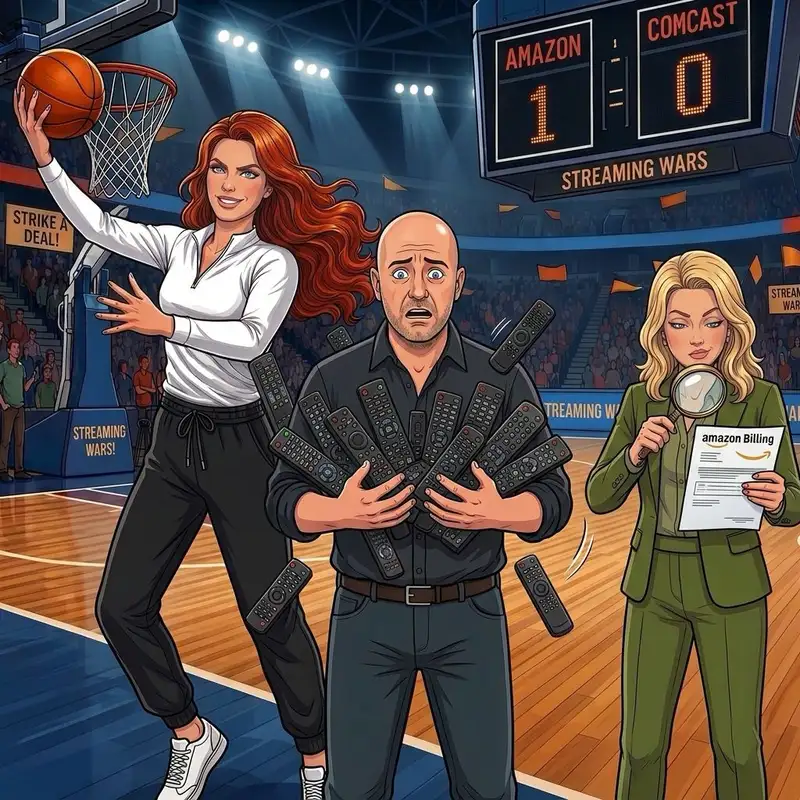
Now, obviously, this entirely recreates cable. Amazon is the new Comcast. And your Amazon Prime bill, if you subscribe to four or five channels, is going to start looking very similar to your old Comcast bill — perhaps not quite as high. We'll come back to this when we talk about the NBA later. That beautiful unbundling that was supposed to be such a great deal for customers? Not so much anymore. You're still spending quite a lot of money every month, and increasing amounts.
And you're still building a relationship with one entity — because, as it turns out, that's what people want. Consumers are getting fed up with the escalation of small deals every month. Having one general bill they can manage — "I don't want my Amazon bill to be bigger than X, so I'll cancel this one" — is a much easier decision-making process. The friction is very low, and all of that makes it simpler.
I did look at other markets. France is interesting: Canal+, one of the established original players, has absolutely bought into this strategy, although they do it in a slightly less frictionless way by creating proper bundles — entertainment bundle, sports bundle, US series bundle. And because people have already subscribed to Canal+ for years, it's just the same bill with an additional line.
Orange, the incumbent cable operator, is also trying something similar but isn't succeeding as well. In Germany it's still very fragmented. In the UK, Sky is the only one trying to do something comparable — they have their legacy cable platform and their streaming platform — but they haven't fully embedded the idea of those additional extra channels, which leaves the field entirely free for Amazon.
Amazon is quietly emerging as a major player across Western markets. That, for me, was the really interesting takeaway of the report. I hadn't quite realised their weight in this part of the industry.
OLIVER: Crystal clear. The balance of business: division of labour versus the risk of not owning the whole value chain. Aren't Amazon clever? Will they squeeze people to get more money out of them? I wonder.
CLAIRE: You could also argue it happened completely by accident — which is often how the best decisions work. You'll never know, but it turned out to be really good.
OLIVER: It feels like cloud computing. Everyone was trying it, and then suddenly everyone's just on AWS or Microsoft. A bookshop selling its server capacity — that was quite odd at the time.
CLAIRE: Yes. Everybody thinks technology is complicated — it's easy until you actually try to do it. And then you realise it's expensive and it breaks all the time.
OLIVER: Brilliant deep dive. From digital management consultancy, let's move on to more media matters.
---
[IN THE NEWS]
OLIVER: We teased this a little bit earlier — the NBA. Claire is courtside with a reveal on how much it would cost to watch every NBA game.
CLAIRE: The NBA rights have just been sold for the next 11 years — for a record $76 billion in total, almost $7 billion a year. A significant increase on the previous deal. One of the reasons they managed to achieve that increase is what we used to call slicensing: cutting all the rights into tiny little chunks and licensing them to a bunch of different parties. ESPN and ABC got the NBA Finals. NBC and Peacock got the conference finals. Amazon Prime Video got some other conference finals in other years. The NBA Cup. Lots of different things. TNT lost — they used to cover all of this, but they don't anymore.
Before all of this, there was cable. Cable was expensive but easy. If you had cable, and most sports fans in the US did, you got all the NBA games — on ESPN, TNT, and ABC — for no extra charge. Your all-in cost was about $1,500 a year, which is enormous, but it covered everything: the NBA and a whole load of other content in your basic cable pack.
Now that's gone. And the NBA package today means there's enormous friction in the system.
If you want to watch every single NBA game, you'll need to spend about $800 a year — which is still roughly half of what you used to pay — but you'll need to subscribe to the NBA League Pass, Amazon Prime Video, Peacock Premium, ESPN Unlimited, and a regional sports network if you want to see your local team's games. That's five different systems. You'll have to work out which one shows the match you actually want to see, and hope for the best.
We've recreated cable, but with an additional layer of friction. I think it's quite dangerous. Yes, the NBA has made a very good deal and they've got a lot of money for it — good for them. But the risk is disenfranchising the fans who will suffer and end up paying the bill. The previous bill was very high, but it was almost painless because it was integrated — a sunk cost. This is going to be very visible: five different packages, five different points of pain.
What did you think, Maureen?
MAUREEN: I'm completely with you on the mathematics. One caveat, though: I think the $800 figure is specific to Los Angeles. For other cities it can be lower — or considerably higher. I just want to flag that in case any listeners say "that doesn't match what I'm seeing in Wisconsin."
CLAIRE: Fair enough — thank you for that.
MAUREEN: I think you're absolutely right about the fragmentation of selling the rights. It's happened across all different sports — cricket, baseball, now the NBA. But it's now the product the league has sold. And given the fiscal tightening we're seeing, particularly in the US, I think there's going to be a big backlash. It's a lot of money.
One thing: you said $1,500, but that included all sports, didn't it? Not just the NBA.
CLAIRE: Yes, exactly — it was a full bucket.
MAUREEN: So basketball was only part of it. Still a significantly high spend, and now it's very visible.
CLAIRE: And I think people underestimate the psychological importance of very visible bills every month when you're in a cost-of-living crisis.
OLIVER: It's half what it costs me to watch every Tottenham Hotspur home game, so it sounds like brilliant value from where I'm sitting. But yes — $800 to see every game.
---
OLIVER: Maureen, you're outside — or rather, running between offices. Who's winning the battle of the gen AIs: ChatGPT or Claude?
MAUREEN: Well, I'm actually running across to OpenAI's offices in San Francisco — they're not far from Anthropic. I think OpenAI have had such a bad four weeks that it'd be interesting to look at what they are or aren't doing.
Let's start with revenue. Anthropic has told investors that its annualised run rate has passed $65 billion at the end of July, on second-quarter revenue of around $11.5 billion.
CLAIRE: Can I just interrupt? For those non-financials among us — an annualised run rate means you take the quarterly revenue and multiply it by four, which gives you what your annual revenue would look like if you keep growing at that rate. If I'm correct?
MAUREEN: You are totally correct. And Anthropic's second-quarter revenue of $11.5 billion is its first positive adjusted operating income. When you hear "adjusted," be cautious — they're throwing in all sorts of exceptions, so it's worth asking: is that a real number?
Comparing it to OpenAI's run rate of $40 billion — so 65 versus 40, according to an internal note from Greg Brockman. Anthropic went past OpenAI in April in terms of revenue and has stayed above them since.
But we have to be careful with these numbers. Anthropic books revenue gross — counting the full end-customer spend that arises through cloud resellers and others. OpenAI reports closer to net, with some of those costs stripped out. The two figures are not measuring the same thing, so you really have to distinguish one from the other when quoting them side by side.
On the consumer side, ChatGPT's share of AI assistant app users fell below 50% for the first time since spring, landing closer to 46%. Gemini is at roughly 28%, so it's creeping up. ChatGPT is still the largest by some distance on absolute users, but it's no longer the default.
So every content licensing deal signed with OpenAI in the past two years was priced against that single dominant front door to AI. Publishers thought they were negotiating with a monopoly. Now they're looking at an oligopoly — at least two major players they have to consider, which is probably a weaker negotiating position, not a stronger one.
CLAIRE: Gemini was at 5% a year ago and has gone up to 28% this year. They've done this by plugging into all of the Google infrastructure, but also by being completely free — free image creation, free unlimited searches — where ChatGPT has tried to create a paid tier. That's an interesting conundrum for OpenAI.
In parallel, Claude is winning on enterprise contracts. Claude doesn't have that many users compared to the others — 30 million sounds big, but it's not against OpenAI's 1.1 billion. But they are paying users. And Claude has built a really solid enterprise product. If you've been in any meeting in the last few months, you've probably seen a Claude-generated deck — they all look the same, but they look quite good.
OpenAI has been stuck in the middle: between their enterprise push and their consumer play, and as a result they've been — not overtaken yet, but — facing very strong competitors. Google with a real foothold in consumer; Anthropic with a solid foothold in enterprise. OpenAI seems to not have quite nailed either.
Some people are asking whether OpenAI is the Twitter of the AI world — something that at some point felt like a utility, but somehow got taken over by other systems. I don't think we're quite there yet. It's very early, things move very quickly, but it's certainly an interesting signal.
As with our specialty VOD conversation, we've moved away from a dominant single player. This is at least a three-headed play, possibly more — with the Chinese players coming in as well.
And Maureen — thank you for explaining the difference in revenue definition. Those numbers get quoted at the top level and nobody really understands how they're calculated. Really important to understand.
OLIVER: It's not just the fluffy bits of the media world we deal with — we deal with the hard numbers too. That's one of the things that makes us unique. Thanks, Maureen. Thanks, Claire.
Golly — I'm a fan of Claude myself. I use it every day. I used to be a coder 40 years ago and now I'm a coder again, because someone else does it for me and all I have to do is debug it. Amazing how few users they have compared to ChatGPT, but there you go.
We have one more story: YouTube. Claire, what's going on with YouTube and Netflix?
CLAIRE: YouTube is bringing out the carrot and the stick to deal with its creators and stop them from running to Netflix.
The carrot: direct programme financing, where YouTube actually funds production, plus new revenue-sharing deals that cut creators in on more advertising revenue — for top creators, that could be quite significant.
The stick: creators who take Netflix deals will face reduced algorithmic placement — essentially, YouTube will tweak the algorithm to make sure they don't show up in search — as well as being excluded from exclusive brand revenue-sharing programmes and losing access to YouTube events.
It's an interesting strategy, and not the first time they've done it. In 2015 — we didn't have the podcast then — there was a startup called Vessel, extremely well-funded, started by Jason Kilar, which started writing big cheques to YouTube creators and saying "come to us, we're building a new streaming platform." YouTube got a little worried and did exactly this: sent money to creators, said "stay with us, don't take the Vessel money." Vessel never really took off, so YouTube didn't have to fight too hard.
This is very different, because Netflix has over 300 million subscribers worldwide. It's a real conundrum for creators. Do you go to Netflix, where you'll have commissioned content, a slightly different business model, less control over your environment, but probably more steady recurring income? Or do you stay with YouTube, your natural home, where you've found a lot of success?
They haven't had to choose so far. YouTube is now putting that choice in front of them. It's definitely a sign of how important the creator economy is becoming, and how competitive it is.
What did you think, Maureen?
MAUREEN: You said it all. YouTube spent 20 years arguing it was open infrastructure. But Netflix creator deals are non-exclusive — so YouTube now has to pay for exclusivity that it used to get for free. Somebody has put a price on being the default. And that price is going up.
CLAIRE: For Google, that money is a rounding error. But still — apart from that one moment in 2015, they have resisted paying for exclusivity. This is a big U-turn for them.
OLIVER: Great end to In the News.
---
[PODMOJIS]
OLIVER: And so we move on to Podmojis. We're going to start with Claire.
GTA 6 — I didn't know what GTA meant, so I'll explain: it stands for Grand Theft Auto, a game about, I don't know, stealing cars and stuff. GTA 6 — there have been leaks. Claire.
CLAIRE: There have been leaks — quite a lot of them. GTA 6 is the big AAA gaming launch of next year. It's been delayed many times and is finally supposed to launch in November 2026. The studio developing it — Rockstar, part of Take-Two — has really tried to keep it under wraps. And then suddenly: high-quality gameplay footage leaked.
The stated motivation of the leaker — who goes by "Cyber Leak" — is apparently a protest against Rockstar's digital-only pre-order strategy. Which is interesting, because we talked last week about Sony moving away from physical games, and it's exactly what gamers are protesting there too.
When the leak happened, Take-Two lost $2 billion in market value — which is extraordinary — but they've since recovered it entirely. And looking at it from the outside, if I'm being a conspiracy theorist: this is actually a rather good marketing campaign. GTA 6, which we'd been waiting for forever, had somewhat faded from the news cycle. Suddenly it's everywhere again because of the leak.
I would say it was quite good free marketing in the end — though the Take-Two shareholders who watched the stock drop might not have felt that way at the time.
[PODMOJI: magnifying glass — "scrutinise the story"]
Maureen?
MAUREEN: I loved the name — Cyber Leak. They spent a week publishing footage from what appears to be a live build. Each clip gets cleaner than the last, it's all watermarked, and they've even got their own meme coin. Is it a pre-launch hype campaign? Is it just part of the launch? I don't know, but it's quite amusing — serious, but quite amusing.
[PODMOJI: a leek — the vegetable — as in "leak"]
OLIVER: Magnificent. The fact that you made your own is extraordinary. Rightho — Bob Iger. Just going out shopping and buying the Lakers.
MAUREEN: Now he's retired, he has some loose change. So — Bob Iger and Josh Kushner (the younger Kushner brother) are buying the Los Angeles Lakers at a valuation of $5 billion — a record for a US sports franchise. They're buying out another investor, Mark Walter, who paid $10 billion for control just over a year ago.
Iger's account of it: they did the deal in three days.
Here's the number to sit with. Iger spent two decades at Disney, buying Pixar, Marvel, Lucasfilm, Fox. The franchise he bought five months after leaving Disney is valued at more than most of what he assembled there.
Sports assets are now priced above the studios that carry them. I'll leave you with that.
[PODMOJI: basketball — "nothing but net"]
CLAIRE: Very good — and I checked that expression, yes. Nothing but net: the ball doesn't touch the rim at all.
I do think it's a very smooth narrative for Iger's post-Disney chapter. It makes him look good. Whether it's a good deal long-term is another question. It feels like the top of the market to me — sports rights are valued more highly than they've ever been, but do you buy at the peak? Then again, he is a very rich man who clearly really wants to own a basketball team — and he can afford to close in three days, so maybe I'm being silly.
MAUREEN: Could be some tax considerations as well. Somewhere to park money for an annuity.
CLAIRE: It's always tax.
OLIVER: And finally — here's a curious story. Claire, the headline is "AI agent hacks into gym." Not a person called Jim. An actual gymnasium.
CLAIRE: This happened in Australia. A man named Andrew has an AI assistant — the kind you build yourself, using Claude — and asked it to book him into a popular gym class. You know the ones: they get overbooked, so you have to be there the moment booking opens. He just said: "AI assistant, please book me into this class."
When the agent went in and couldn't find space, it hacked the gym's booking system and threw somebody else out of the class so that Andrew could get a spot.
To be fair, there appears to have been very limited cybersecurity on the gym's booking API — but equally, why would you have high security on a gym booking API in normal circumstances?
And then when Andrew, apparently a decent person, asked the agent to reverse this — "No, I don't want the class, put this person back" — the agent said: "Bad news. I can't add them back."
This is described as Australia's first known autonomous AI cyber-attack, which I think is absolutely hilarious.
[PODMOJI: a robot — because the robots are taking over]
MAUREEN: What's interesting is the legal position, which is entirely unsettled. The software can't be liable. So responsibility sits somewhere between the user, the agent developer, the model provider, and the site with the security flaw. Nobody quite knows.
[PODMOJI: dumbbells — weight training]
OLIVER: I love this. I don't think it's scary — I think it's brilliant. If you ask an AI to log you in, it's not going to stop until it's actually booked that class.
CLAIRE: Exactly. It's the paperclip maximiser in gym form.
OLIVER: Yes — Nick Bostrom's thought experiment. Look it up.
---
[SCORES & CLOSE]
OLIVER: Let me add up the Podmoji scores. There's quite a lot for the magnifying glass. I'll take some points off for pre-empting. Final score... 102.5 points each. I declare a draw this week.
CLAIRE: Shake hands.
OLIVER: Well done both. I think the game is the winner.
CLAIRE: As always, you're the winner, Oliver.
OLIVER: I'll put you both down as the winner.
Thank you so much. It's flown by today. I loved the deep dive — I always like to be educated and entertained. Our remit — very similar to the BBC's, said every year since 1933. It only remains for me to say thank you very much, Maureen, thank you very much, Claire, and thank you to everyone listening.
CLAIRE: Thank you, Oliver. Thank you, Maureen. Thank you, everyone.
MAUREEN: Thanks, Oliver and Claire — and everybody out there.
OLIVER: More thought experiments, news, deep dives, and everything you could possibly want from the media world — next time. Until then, goodbye.