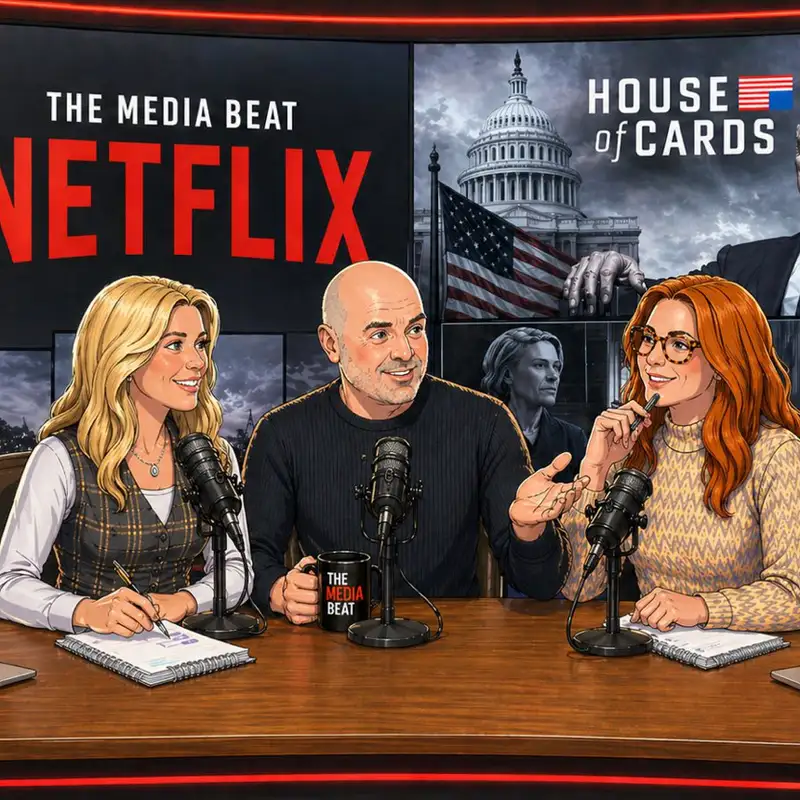
Netflix Pivots to Attention, AI studios and a Golden Pear Affair | The Media Beat #94
THE MEDIA BEAT — EPISODE 94
Clean Transcript
Hosts: Oliver Turnbull, Maureen Kerr, Claire Tavernier
---
INTRO
OLIVER: Hello, one and all, and welcome to The Media Beat, episode 94. Apologies if I've lost my voice slightly — I had a rather large birthday over the weekend.
MAUREEN: Oh, happy birthday!
CLAIRE: Happy birthday!
OLIVER: Thank you very much. Can you believe I'm now at an age with a six in front of it? Someone at work — a Gen Z person — asked how old I was. I said 60. They went: "Oh, aren't you doing well?" First time I've been patronised by a Gen Z. I thought it was quite sweet. Anyway, I'm still dressing myself, so.
We have a show. We're going to be talking about BBC and Meta — things not going very well there. iQIYI, otherwise known as the Netflix of China. Paramount and WBD, of course — Zaslav, friend of the show. P&G and microdramas. Bolloré's takeover of Grasset, lots of things — and a surprise.
But first, the main event: a deep dive on Netflix. We've talked about Netflix on almost every episode, and it turns out — having checked — we have never actually done a proper deep dive on it. So today we fix that. Leading it from a business angle is our very own Maureen Kerr. Maureen, take us through the story of Netflix.
---
DEEP DIVE: NETFLIX
MAUREEN: Right. Netflix is often described as the winner of streaming, but that's only partly right — because Netflix has never really stayed in one business long enough to be defined by it. Roughly every five to seven years, the company has changed what kind of business it is in.
DVD by post became streaming. Streaming became original content. Original content became global subscriptions at scale. And subscriptions became, perhaps surprisingly, advertising and paid sharing. And now Netflix may be changing again — from a retention business into a yield business. That context is important, because Netflix's biggest pivots tend to look obvious only in hindsight.
The first Netflix was not a streaming company at all. It was a DVD-by-post company. Its original innovation was convenience: no late fees, a larger catalogue than the local video store, and discs delivered to your door. It competed with Blockbuster by making the older rental model easier. Then in 2007, Netflix launched streaming — at first as a free add-on for DVD subscribers. It didn't immediately replace the core business; it sat beside it. But Netflix understood earlier than most that the delivery system was changing. The internet was going to replace the post box.
Who remembers the Qwikster episode in 2011? It's a useful moment because it shows Netflix separating strategy from execution. Netflix tried to split the DVD and streaming businesses into two separate brands. Customers hated it. The stock market punished them. Netflix reversed the decision. But the underlying strategic call was right — DVDs were legacy, streaming was the future. The execution failed; the direction held.
The next pivot: content. Early Netflix streamed other people's shows and films. That worked while studios treated Netflix as extra revenue. But once streaming became the future, those same suppliers became competitors. Disney, Warner, NBCU, Paramount — they all eventually wanted control over their own libraries. So Netflix had to become a producer. House of Cards in 2013 was the symbolic moment. Netflix was no longer a distribution platform. It had become a studio.
That created the Netflix model of the late 2010s: spend heavily on content, drive viewing up, reduce churn, add subscribers, raise prices over time. In other words, Netflix became a retention business. Hours watched counted because they were a proxy for habit. The more people watched, the less likely they were to cancel. For investors, that model was relatively easy to understand, even if it was expensive to run. Content spend created engagement. Engagement reduced churn. Low churn supported pricing power. Pricing power justified more content spend. The whole machine was built around keeping people inside the subscription ecosystem.
Then came the 2022 shock. Netflix lost subscribers. The stock fell hard. The company was forced to do two things it had insisted for years it would never do. First, it launched an advertising tier. Second, it cracked down on password sharing. Both moves changed the model. Advertising gave Netflix a way to serve more price-sensitive users without simply discounting the product. Password sharing enforcement turned some non-paying viewers into paying customers — or pushed them off the platform entirely. The company returned to growth. But those changes also set up the next pivot.
Netflix is no longer asking: how do we keep subscribers watching? It's asking: how much value can we generate from each visit to the app? That is the shift from retention to yield. Retention is about whether people stay subscribed. Yield is about how much value Netflix can extract from each unit of attention.
That frame really does depict what's happening now. The redesigned mobile experience — which we discussed back in January — is aimed at the opening moment: the moment when someone opens Netflix without knowing what they want. That is one of the hardest problems in streaming, and no one has fully cracked it. The catalogue can be enormous, the recommendation system can be good, and the user can still bounce because choosing something genuinely feels like hard work.
Netflix's answer is vertical discovery — short clips, autoplay, a feed that lets viewers move from scene to scene before committing to a title. That does not mean Netflix is becoming TikTok. The distinction matters. Netflix has added vertical discovery; it has not moved into vertical drama in the way short-form platforms have. Vertical is where Netflix wants you to find something. Horizontal is still where it wants you to watch.
In the old model, a successful session meant a long viewing session — hours and hours. In the new model, success begins earlier. Did the app open? Did the user find something quickly? Did Netflix keep that attention inside its own environment? And if the user is on the ad tier, did that visit create monetisable advertising inventory?
This is where the advertising business becomes central rather than incidental. Netflix expects around $3 billion in advertising revenue this year. The advertiser base is growing quickly. Programmatic buying is becoming a larger share of non-live inventory. And in markets where the ad-supported plan is available, a majority of new sign-ups are choosing it. At that point, advertising is not just a bolt-on — it starts to change what kind of company Netflix is.
A pure subscription company wants viewing because viewing reduces churn. An advertising-supported company wants viewing, but it also wants frequency, targeting, inventory, and yield. It wants more reasons for people to open the app, more surfaces on which to sell attention, and more formats that bring people back without requiring a two-hour commitment. That explains the other products: live events, video podcasts, games, the mobile redesign — and it helps explain why Netflix is investing in AI-enabled production tools, including the Interpositive acquisition — Ben Affleck's generative AI filmmaking company, framed as creator tooling but also, inside this broader shift, a supply-side investment.
If Netflix is creating more services, more formats, more entry points, and more reasons to open the app, it also needs cheaper, faster, and more flexible content supply chains. This does not mean Netflix is abandoning premium television or film — quite the opposite. Premium content becomes one part of a wider attention system.
So the traditional Netflix question was: what shows keep you subscribed? The new Netflix question is broader: what combination of shows, films, clips, live events, games, podcasts, recommendations, and ads creates the most value from each membership relationship?
This brings us to today. The Q1 results were interesting — the reaction was very interesting. The headline numbers were strong: revenue up 16%, operating margin above guidance, net income rising sharply (though slightly distorted by the determination fee from the WBD situation). The core business was still growing. And yet the stock fell just under 10%, which is quite significant. Part of that was Q2 guidance. Part of it was earning optics. Part of it was Reed Hastings — one of the original founders — announcing he will not stand for re-election as board chair in June.
But the deeper issue, I think, is that the market is still deciding what company it is trying to price. Because Netflix is reinventing itself. If Netflix is just a mature video business with an advertising tailwind, then the current valuation looks demanding. Mature subscription businesses eventually slow down — there are only so many households, only so many price rises, only so many hours in a day. But if Netflix is becoming an attention yield business — which is where I think it's heading — then the comparison set changes. The relevant questions are no longer subscriber growth and churn; they're ad load, ad pricing, frequency of visits, live event acquisitions, gaming engagement, efficiency, and the cost of content supply. That is a different business.
As for Hastings himself — his departure from the chair role is symbolically neat but operationally less important than it looks. He stepped down as co-CEO in 2023. The company has already been running under Ted Sarandos and Greg Peters. His exit closes the original Netflix chapter. But it does not create the new strategy. The new strategy is already visible in the product. That has usually been the case for Netflix — the product changes before the market fully catches up on the story.
The DVD company became a streaming company before the financial model was obvious. The streaming company became a studio before the industry accepted the scale of original content. The subscription company moved into advertising after insisting for years it would not. And now the streaming winner may be trying to become something broader — a system for monetising attention across multiple formats, surfaces, and price points.
The question is not whether Netflix won streaming. The question is whether streaming is still the right category for Netflix. If Netflix is a subscription business, the stock is expensive. If Netflix is a yield business, the market may still be very early in understanding what it has become. Reed Hastings's departure marks the closing of the chapter in which Netflix was unambiguously a subscription story. What comes next is still being priced.
CLAIRE: That was incredible, and it's going to be hard to follow. I completely agree that Netflix is hugely impressive as a market maker — in the same way that Google or YouTube has been — constantly reinventing itself without necessarily waiting for a strong signal that it needs to. And quite happy to say: we said we'd never do this, but actually it makes sense now. I admire that.
All of that is true. I do also believe it's going to face quite significant challenges. Because some of their recent moves are clearly driven by awareness of a key danger: the disappearance of their library content.
Remember, in the old subscription-only model, it didn't really matter how much any individual user watched — revenues didn't change based on viewing hours. But once you add advertising on top, it becomes very dependent on volumes, because your advertising revenue is directly proportional to how many people watch a show. You want hours and hours being consumed.
And that's a problem, because the Netflix library today is still roughly 50% third-party content — and that window is closing fast. Disney is moving all of its content out. If the Paramount-WBD merger goes through, that content will leave too. Fox content is out. Sony TV content is largely co-productions they won't have access to. We're talking about shows with 24 episodes over 10 years — decades of hours of content, going away.
If you look at Netflix's content strategy, they've quietly doubled down on returning series over the last few years: Bridgerton, Lincoln Lawyer — a pretty traditional procedural legal drama. Yes, they're still doing prestige miniseries — Adolescence, et cetera — which are wonderful at bringing people in. But in terms of hours, these are quite small. Returning series are much more efficient at reducing churn. Netflix is still best in class on churn compared to competitors, but with all that library content leaving, that may well change.
So what are they doing? They're leaning into sports, live events, podcasts, non-English language content — all of which makes their library look stronger. But the truth is, a lot of the content that made Netflix the default streaming utility, the place people turn to first when they don't know what to watch — that early-mover advantage is going away. They are clearly aware of it and working very hard to replace it. It'll be a fascinating story to watch.
OLIVER: Wow. That was a tour de force — both of you. Beautifully constructed. Structure, eloquence, surprise, a bit of emotion — everything that makes a deep dive memorable. Right, we should crack on, if that's alright. Into the news.
---
NEWS ROUNDUP
OLIVER: First up: some not very good news. Meta and the BBC both announcing layoffs. Claire?
CLAIRE: Not a great week whether you work in media or tech. Let's start with the BBC. The number is quite high, though the timing is perhaps the most interesting part. The BBC has announced it plans to cut up to 2,000 jobs — 10% of its workforce — in order to save £500 million over the next two years. The drivers are well-known: declining license fee income, inflation, rising production costs, a dramatically different competitive landscape.
What's interesting is the timing. Tim Davie left as Director General on April 2nd. The new DG, Matt Britton, starts on May 18th. So the announcement landed squarely in the interim — made by the acting DG. I think that was quite smart. Tim Davie clearly didn't want this as his legacy; Matt Britton didn't want it as his opening act. But it still needs to happen, and this window was used to get it done. It also puts some pressure, I suspect, on the government as they consider license fee and charter renewal. But frankly, I don't think there's a huge conspiracy here — they needed to do it, they knew they needed to do it, and this window gave them the opportunity.
Meta is also laying off 10% of its workforce — around 8,000 jobs — starting in May, and freezing 6,000 planned hires as well. Not a great moment to be working in that part of the world. The reason: they're pivoting to AI. The metaverse, it turns out, was not quite as transformative as everyone thought. Horizon Worlds and the Quest VR project are being wound down or put on hold. All of those resources are being redirected into AI, which makes sense — there are much more direct and obvious business implications for Meta in AI than there ever were in the metaverse. Still a painful moment for the people involved, but the strategic logic is clear.
MAUREEN: On the BBC side, the timing is really interesting. It clears the way for Matt Britton to focus immediately on what he needs to work through very carefully with government — the license fee and universal service questions. He's got a lot to do, and at least he won't have to be the one making the redundancy announcement.
OLIVER: And for the record — we were cold on the metaverse on this show. Turns out we were right to be.
CLAIRE: This is one where I'll say: I called it. I really did not believe in the metaverse as it was being described.
---
OLIVER: Next up — iQIYI. Known as the Netflix of China. Maureen, what's happening?
MAUREEN: iQIYI has been in the news over the last week or so because its CEO has made a very interesting statement about where it's taking the business — specifically around AI content. And rather than talking about it, they are shipping.
They've launched what they're calling NADO Pro — an AI-native production suite for creators. It provides almost 70 AI agents covering script writing, directing, visual design, editing, and other parts of the production workflow. And creators using this suite can also access iQIYI's own intellectual property — its library, shared digital assets, virtual sets, props, AI-rendered characters, and distribution infrastructure. It's going full-hog AI platform.
There has, predictably, been some backlash. Some actors whose likenesses are in their database are pushing back hard, saying: we need rights, we need negotiation, we need compensation. iQIYI's CEO has said that likeness rights still need to be individually negotiated — they're simply providing the platform to the community. It's a little vague in places, but nonetheless it's a bold move. Compare it to what Netflix is doing through Interpositive — Netflix is opening the door cautiously. iQIYI is essentially saying: we are doing absolutely everything.
They're also promising a commercially released AI-generated feature film this summer. We'll be watching that closely.
CLAIRE: They announced all of this at their annual World Conference, which — I hadn't realised — is quite a significant event. Some actors are pushing back, but others are embracing it. And I think the acceptance of AI-generated content in China is genuinely different — and considerably higher — than in the Western world right now. That will naturally affect how all of this lands and develops. Wait and see — a story that will run and run.
MAUREEN: Especially after this summer, once we see whether that commercially released AI-generated feature film materialises and how it's received.
---
OLIVIER: And of course — Paramount-WBD. Claire, a quick update.
CLAIRE: Quick as I can. The WBD shareholder meeting was held on April 23rd, voting on the Paramount-Skydance merger. We don't have exact stats, but WBD has said shareholders voted almost unanimously — "overwhelmingly" was their word — in favour. Final results to be certified. It's a green light from shareholders, though the regulatory pressure very much remains.
They also voted overwhelmingly against David Zaslav's golden parachute — but that vote is non-binding, so it doesn't settle the matter. The board of the new joint entity will have to decide whether to face the shareholder backlash and pay it in full, or soften the terms. It's possible they went in high knowing they'd have to climb down a little. Either way, I'm not particularly worried about Mr. Zaslav's financial future.
MAUREEN: The record now reads: investors approved the merger, but rejected the mythology of Zaslav's turnaround.
CLAIRE: That's a very good way to put it.
OLIVER: And our prediction on the record: he probably won't starve. He'll get some money. Possibly a little less money.
---
THE PODMOJIS
OLIVER: Podmoji time. Fingers off the buzzers — which don't exist. First up: P&G and microdramas. Maureen, set the scene.
MAUREEN: Procter & Gamble, through their personal care brand Native, has launched The Golden Pear Affair — a 55-episode vertical microdrama, produced in partnership with Dentsu Entertainment. It's built around a jewellery heist, a missing sister, a globe-spanning romance, with products like the Japanese Golden Pear and the Turkish Rose Water collection woven into the story itself. The distribution model is also interesting: the first episodes are free across social media platforms, and then — once you're hooked — you have to go to the site and pay $9.99 for the full run of individual episodes. We'll see whether people actually do that.
But the historical dimension is what really grabbed me. In the 1930s, Procter & Gamble helped shape the television soap opera by sponsoring serialised entertainment around household brands — soap, hence "soap opera." That was 90 years ago. And now, the brand isn't just sitting next to the story. The brand is inside the story again. This isn't competing with a TV pilot. It's competing with a media plan. I love this.
CLAIRE: Soap operas are, of course, named for exactly that Procter & Gamble sponsorship model. That's why they're called soap operas — it started on radio, not television. As for the P&G move: I think it's a good story and the headlines have paid for themselves. The bit I'm less sure about is asking people to pay for content at the end — that's quite a big departure from the original soap opera model, which was all about brand awareness and sponsorship. I wouldn't have gone that way. But if they publish the results, great. If they don't, that probably tells its own story. My Podmoji: glasses on, looking slightly doubtful.
OLIVER: Very good. Quizzical. Fair enough.
---
OLIVER: Next: Bolloré takes over Grasset. Claire.
CLAIRE: Vincent Bolloré is a French media owner and billionaire — very conservative — who has been quietly building a media empire. He owns 30% of Vivendi, through which he owns Canal+. He acquired the Journal du Dimanche — France's only Sunday newspaper — in 2023, immediately fired the editor, and slashed the newsroom from 100 journalists to four, effectively turning it into a mouthpiece. He also owns Hachette, a major publishing house, and has just used Hachette to acquire Grasset.
Grasset is, to give a sense of it — Penguin might be the closest equivalent. It's a legendary publishing house in France. The kind of place where the really serious intellectual and avant-garde writers want to be published. Within weeks of the takeover, Bolloré fired the CEO and published a column in the JDD explaining his intentions. 170 authors have walked out and refused to be published under his ownership.
It's sparked a genuine fear in France. Through his C8 channel, he has built up the far-right figure Eric Zemmour, who went on to run for president. He's trying to become a kingmaker by taking control of the French media — and in France, book publishing still carries real cultural weight in a way it perhaps doesn't in other countries. It's a big deal. It polarises French media further, and it makes me genuinely sad.
My Podmoji: sad face.
MAUREEN: There may be some light at the end of this tunnel, though — and it's about rights. The 170 authors who walked out are now lobbying hard for something called a "conscience clause." This exists in journalism for newspaper journalists: if the new owner's political stance is incompatible with yours, you can invoke the clause and your rights walk out the door with you. The authors are pushing hard for this to be inserted into standard publisher contracts. If they succeed, a buyer may acquire the name and the building, but writers can still carry the value with them when they leave. Fingers crossed. My Podmoji: this is a prickly story.
OLIVER: Very nice. A prickly story indeed.
---
OLIVER: And finally: prickles on set of White Lotus? Question mark, question mark. Claire.
CLAIRE: White Lotus season four has just started shooting in France — in Provence, where it will be set. About a week into production, Helena Bonham Carter, one of the big names signed for the season, has left. Nobody knows why. The official statement says it was all very amicable, but departing that early in production is quite a significant disruption. They'll need to rewrite, recast, probably reshoot, talk to their insurers about production insurance clauses, get the writers back in the room, and redo the schedule. It's a huge amount of lift. I can only think of one comparable example — the recasting of Aragorn in Lord of the Rings, very early in production. Quite rare.
I don't know what happened. Nobody does. It's possible it simply didn't work once they were on set. We all want to know. My Podmoji: tea.
MAUREEN: Mine is sunglasses, a sun lounger, Provence, and a glass of rosé. There's nothing more to add. I'm simply waiting for the phone call to be cast.
CLAIRE: You'd be amazing in White Lotus. Let's put that idea out there.
OLIVER: Consider that noted. And on that brilliant note, we'll call it a draw this week — 1.15 points each.
---
OUTRO
OLIVER: Wonderful deep dive. Thank you, Maureen and Claire. It only remains to say: goodbye and thank you, Maureen.
MAUREEN: Thank you, Oliver. Goodbye.
OLIVER: Goodbye and thank you, Claire.
CLAIRE: Goodbye and thank you both. Looking forward to the next one already.
OLIVER: As am I. But for now — bye-bye.
---
END OF EPISODE 94