Non-English TV, Netflix Wobbles and Emmy Nominations | The Media Beat #99
THE MEDIA BEAT — EPISODE 99
Transcript
---
DEEP DIVE: Non-English Language Content
Oliver Turnbull:
Hello everybody and welcome to The Media Beat, episode 99. Will we get to the big hundred? My money is on yes. I hope you have all had a great time since last time — we have been preparing an episode fit for you, our wonderful listeners.
So we're starting with one which I thought was going to be a bit contentious: the deep dive on non-English language content. Being something of an anglophile, I just wondered whether there was such a thing as content not in English — but I'm told there is, and Claire's probably looking a bit cross now.
I'm joking, of course. I'm going to be fascinated by this, and both Claire and Maureen are obviously going to contribute, as usual. It's going to be a brilliant one and a bit of a shift. We really need to focus on things beyond all things English.
We'll talk about BBC and Channel 4 talking together, Netflix results, dodgy things happening at Xbox, the World Cup — of course we'll be touching on that. Both Claire and I are in mourning; we're recording this very shortly after both our beloved teams were dumped out of the World Cup under different circumstances. We haven't moaned about it too much. Chinese AI will be mentioned, and of course the Emmy nominations. But let's start with Claire on this fascinating subject — non-English language content.
Claire:
Yes. What spurred our decision to discuss it was that for the first time ever on Netflix, non-English language originals have overtaken English language originals. 50% of the platform's library of originals are now not in English. And that got me thinking about what was going on.
Obviously there's much more comfort now among English language audiences in watching non-English language content. Coming from France, I was always much more comfortable with it.
I'm going to start with Mussolini — because it's been a while since we've mentioned Mussolini on the podcast, and it's always a good time. If you've ever been to Spain, Italy, Germany, or France and switched on the hotel television, you've probably watched Bruce Willis speak whatever language is local. Dubbing in Southern and Central Europe is very much the standard. But I always thought it was a cultural and artistic choice — and actually, it started with mid-century authoritarian censorship.
When the first talking movie came out — The Jazz Singer — studios had no idea what to do. Suddenly there was spoken dialogue and they couldn't use intertitles. They decided to put words on screen because it was easier, and that was the beginning of subtitles. Hollywood then tried shooting the same movie multiple times with different foreign-language casts. That obviously didn't work out, so they moved to dubbing. But then the politicians stepped in. In 1929, Mussolini banned foreign language dialogue in films, which allowed the government to censor the language and the words. There was a strong push to suppress regional dialects and unify everything around the Italian language. In 1931, there was a direct reference to Mussolini in an American film, but in the Italian version — it simply isn't there.
Franco did exactly the same in Spain, partly to marginalise Catalan and Basque. In post-war Germany, the dubbing system was kept to quietly edit uncomfortable references. There's a famous example: Notorious, by Alfred Hitchcock, where the Nazi villains become generic drug smugglers in the German version. You can do a lot with dubbing that you can't do with subtitling.
Moving on to the post-war map — Southern and Central Europe: France, Germany, Italy, Spain, remained heavily dubbed markets. Northern Europe — Scandinavia and the Netherlands — went for subtitling. Not so much because they loved English, but mostly because their markets are small and dubbing everything was prohibitively expensive. Meanwhile, the UK and US, as per you, Oliver, developed virtually no appetite for foreign language television at all. It was a completely non-existent category, either dubbed or subtitled.
During that period, US content in Europe was absolutely dominant. In Germany, at some point, 60% of all major theatrical and television releases were dubbed imports, mostly from Hollywood. The dubbing industry became highly sophisticated — voice actors became stars. The voice of J.R. Ewing in Dallas in France is very well known and recognised across many other characters. I certainly grew up thinking The Cosby Show was a French-language programme.
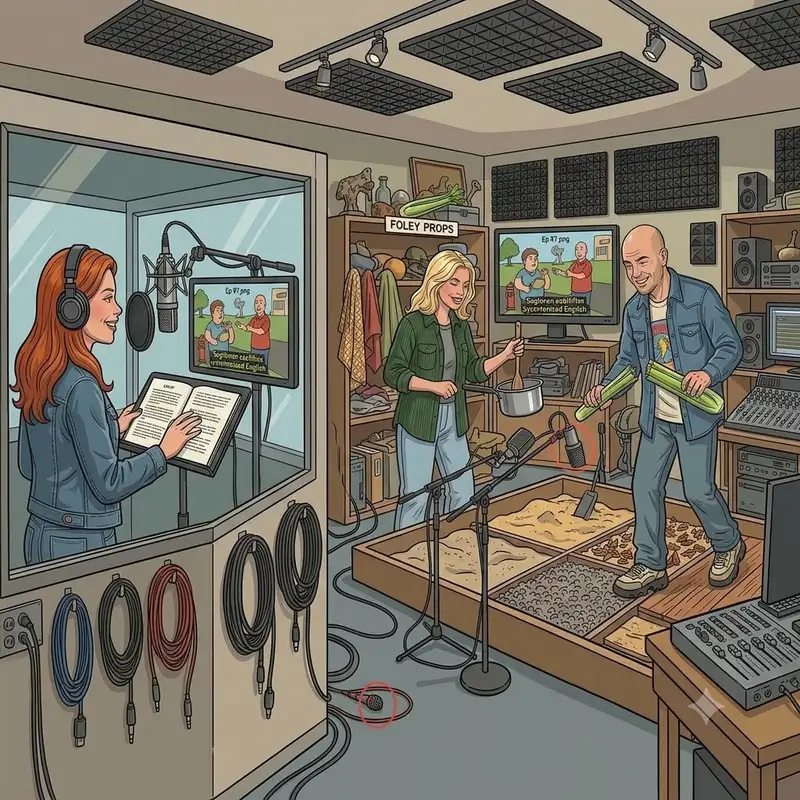
Now, I want to spend a moment on Foley artists — I love these behind-the-scenes stories. When you strip dialogue away from a movie, you lose a lot of ambient noise: the footsteps, the rustle of fabric. With the first few dubbed movies, there was a jarring artificial silence whenever the dubbed voices started. To solve this, Hollywood reinvented post-production and created what is known as the music and effects track — the M&E track. To sell a movie internationally, you have to deliver an audio master without the dialogue but with all other sounds. To do this, you have Foley artists. I've seen them at work in a studio in Hollywood. They recreate ambient noises with physical cheats: a snapping bone is a celery stalk or a head of lettuce broken in front of a microphone; horses are empty coconuts; walking through snow is leather pouches filled with cornstarch; a bird flapping its wings becomes gardening gloves, and so on. They've tried replacing this with AI, Maureen — and it doesn't quite work. It really is about creating sound in a very analogue way. It's a remarkable job that still happens today.
That said, 2012 was a real turning point when Netflix launched its first original bilingual show — Lilyhammer — a bilingual Norwegian and English comedy. It was heavily Norwegian, apart from Steven Van Zandt speaking English, and it became a massive hit. Suddenly people realised: oh, that could actually work.
Over in the UK in 2016, the breakthrough was Walter Presents, which may still be a major strand on Channel 4. It actually started a bit earlier on BBC Four with The Killing, Borgen, and Spiral — a brilliant French show. Walter Iuzzolino, Italian by birth, became the curator of that strand on Channel 4. English-speaking audiences — sophisticated English-speaking audiences — suddenly discovered they were happy to watch subtitled television, as long as it was really good television.
That was the beginning of an incredible shift. Remember, we're talking about markets that had zero foreign content — literally zero, either dubbed or subtitled. We have now moved so far that the biggest franchise of all time on Netflix is in Korean: Squid Game. Netflix has scheduled 34 Korean titles for production in 2026, and Indian titles are also having a breakout year. That's even extending to the Oscars — with Parasite winning Best Film, which is extraordinary. This year, Sentimental Value, a Norwegian film, won Best International Feature but also received nominations for Best Actor and Best Actress. We're seeing a much, much wider audience for foreign language films.
I was also interested to find out who these people are who are so much more comfortable watching subtitled or dubbed content. It turns out it's mostly young people. Gen Z and millennials: 76% of them are very comfortable watching foreign language content, compared to 56% of all viewers. They also prefer subtitles quite significantly over dubs — but the interesting thing is they prefer subtitles on everything. These are people who will watch anything with subtitles, not just foreign language. Since they have subtitles anyway, they don't mind if the dialogue is in another language. This is a generation that's grown up on TikTok and YouTube and is simply much more comfortable with reading while they listen.
We do still have strong regional differences. Asian markets — South Korea at 72%, China at 71% — overwhelmingly prefer subtitles. Russia: 86% prefers dubbing. Germany: still 76% prefers dubbing. Italy: 73%.
One last thing before I hand over to Maureen. The research I read noted a slight lean: men lean slightly more towards subtitles compared to women. Two factors were cited — a higher concentration of genre film purists among male viewers, and the fact that women tend to multitask while watching, making it harder to read at the same time.
Dubbing and subtitling used to be done on a localised basis, but the big platforms now have to set up industrial systems to dub and subtitle in 30 languages simultaneously from the start. I'll hand over to Maureen to talk about how they're doing this with new technologies.
---
Maureen:
Everything Claire has described rests on a technology story that has moved faster than the industry realised. But I want to pick up on the Foley point, Claire. The Goons — which housed Peter Sellers and others — actually did that very thing on radio: they shook rice cans, trod on celery stalks, recreated the sounds of a play using household goods. It was brilliant. And some of it was filmed, so you can still watch them doing it.
AI has now taken on that challenge, and I'll mention a company in a moment that I believe is genuinely achieving it. But as Claire alluded to, there's a cultural dimension to the difference between listening in your own language, watching subtitles, and dubbing — and then there's the cost and the technology. The reason a lot of studios avoided dubbing was the sheer cost. I was looking at figures of around $200 a minute for a typical dubbing studio, which is really prohibitive. They would only do it for certain films with a proven audience. They didn't serve the UK market because the UK market, for whatever reason, simply wasn't interested.
That wall between the viewer and the studios is definitely coming down. I've noticed three different types of companies offering these services.
The first is pure AI voice companies. One I love is ElevenLabs, which now offers dubbing as a largely automated pipeline — translation, voice cloning, and synchronisation, all in one process, across around 90 languages. The finished version can be delivered in a clone of the original speaker's voice. At a broadcast level, human translators still remain part of the chain, but the AI is doing a lot of the heavy lifting.
Another company — Respeecher, a Ukrainian company with a wonderful founder named Alex — comes at the same problem from the craft end. They won an Emmy a couple of years ago for their voice work. Their credits include The Brutalist, where they mastered the Hungarian voice at the start of the film, and also Emilia Pérez. I think at the time we spoke about it mostly for the industry's backlash rather than the quality of the craft.
The second category is the large technology platforms. This is where the sound of celery snapping is something the larger AI companies are now addressing. ByteDance in particular recently released an offering called Seed — a real-time speech-to-speech interpretation model that can clone a speaker's voice with a delay of only three seconds. The filmmakers I'm speaking to are using it and it is impressive: you can get an entire scene, multiple voices, all the ambient sound — in one single pass. The latest video models can produce footage with native multilingual dialogue already built in.
There's also Pika Drama, which owns a distribution service for short-form drama and is building machinery that can make any drama speak any language. So you've got distribution and translation under one roof. That's a different kind of power.
That's not to say the traditional localisation companies are being displaced. One of the biggest is IYUNO, a consolidation of multiple companies through an acquisition spree over about a decade. It's absorbing the technology rather than simply being replaced by it. Companies like Amazon, Netflix, and Disney are all incorporating AI into workflows covering more than 100 languages. There's also DeepDub, which has already achieved Hollywood vetting and can dub live sport in real time — extraordinary.
In practice, AI is now managing continuity and quality control within the production pipeline, with humans retaining creative approval. If it looks slightly out of sync, or the celery sounds like celery when it shouldn't, they step in and take control. AI is really enabling studios, content creators, and AI filmmakers to work with audio and sound. A filmmaker said to me the other day: 90% of what makes a great film great is sound. He corrected me when I said, "Oh, you mean music?" He said, no — sound. And I understood him completely. That was Kevin the Kid — little shout out for you, Kevin.
What underpins all of this is the rise of new AI systems that underpin the technology. Fascinating topic. I'm so glad you brought this forward, Claire — it has that lovely history, Foley artistry, Mussolini, goodness me — and also forward-looking technology. Including live sport.
Claire:
Before we move on, I also want to shout out ZOO Digital — a Sheffield-based localisation vendor that works with all the major Hollywood players. Still quite small, but also trying to find that balance between technology and the human in the machine. Because we do still need that human. The conclusion is: you can't quite yet match human voice actors for deep, dramatic, emotional nuance. You might at some point, but we're not quite there yet.
I'll finish with this: in the mid-nineties I was in a cinema in Moscow — don't ask, long story. The way they handled dubbing then was to simply play the film on screen while one man sat next to it, reading all the dialogue in Russian over the English words. The same guy did every voice, in the same flat monotone, just reading the lines as they came up on screen. It was the most basic dubbing I've ever seen.
Oliver Turnbull:
Did he do a high voice for the women?
Claire:
Nope. Just the same voice.
Oliver Turnbull:
No effort at all. Very Russian.
Maureen:
All the AI filmmakers I've been talking to over the last couple of months say there's something quite special about a trained actor and the emotion they impart through their voice. Nothing can replace it at this stage. They're using actors' voices and then manipulating them in the AI — but they still say: we need actors. We still need those voices.
Claire:
Good news, I think.
Oliver Turnbull:
Every AI story we do always has a human element too. You'll never get Richard Burton AI'd.
Maureen:
What a voice. Or Orson Welles.
Oliver Turnbull:
That lovely Welsh voice. And if you ever want an amusing look at an actor who's had a little too much to drink, look up the Orson Welles champagne advertising outtakes. Absolute gold.
Oliver Turnbull:
Isn't it fascinating how some people like subtitles and some like dubbing, and it's so distinct by country? And how you get used to reading subtitles and forget you're doing it. Anyway — that was even better than I expected, and I expected something very good. Fantastic. We must move on to In the News.
---
IN THE NEWS
Netflix Q2 Results
Oliver Turnbull:
We'd generally go to Maureen for a business story. She is at the Finnish headquarters of Netflix in Helsinki for some reason. She has her raincoat on and a clipboard, and she is going to report on the Netflix results with her fantastic analysis. Maureen.
Maureen:
Helsinki — that's a first. I was up late last night listening to the earnings call, but I want to do a small plug — I did a preview of the results in Forbes last week, where I was waiting for three questions to be answered by Greg Peters and Ted Sarandos. I'll give a condensed version.
Overall, their second quarter revenue and profitability were in line — absolutely nothing wrong. The results were great. But the stock fell overnight by 9%. And that's not great, especially when you look at the fact that the stock has fallen 40% over the last year. The problem is the forecast. As Claire and I say time and again — managing expectations.
The guidance was well below Wall Street's expectations for the second quarter running, and shares were down. The market isn't punishing Netflix for what it did, but for what comes next.
My three questions: First, viewing hours. The answer we got was 2% growth across the first half. But against a content spend rising by roughly 10%, spending is growing five times faster than viewing. In layman's terms: their advertising business needs to fill the gap. I was looking for affirmation of their $3 billion advertising target — that was confirmed, with all US upfront commitments closing in the next couple of weeks.
Second, the argument that raw viewing hours understates the audience. Greg Peters said it almost verbatim: "All hours are not created equal." Live programming — which they're betting significant money on — is 5% of spend but only 1% of hours. Yet six of the ten biggest signup days are due to live events: boxing, tennis, and others. That's quite significant.
Third — and there's been much commentary about Netflix dumbing down, signing podcast deals, etc. — we were all waiting for the engagement report, the "What We Watched" report. They're moving it from twice-yearly to annual, and they're no longer tying it to earnings. That's a signal in itself.
On the free tier: there's been churn from people who find it too expensive. Netflix confirmed they are doing free trials, being tested in several countries — but only if the advertising economics justify it. And on generative AI, Ted was proud to note that 300 of their titles are using generative AI in either pre- or post-production, with one — an American experiment documentary — using 17 minutes of AI-generated content.
All in all, the market is frustrated. They're not sure of the direction. Netflix has done some great deals — podcasts, publishing partnerships with Condé Nast — and I think that's all volume-driven to help justify their advertising yield and get to that $3 billion target. Claire, I know you'll have a view.
Claire:
Yes. I don't think they managed the narrative very well — though I suspect they didn't have a choice. The worry is around engagement, which now matters much more than it used to. When Netflix was subscriber-only with no advertising, you didn't really care if people didn't watch as long as they kept subscribing. But now that 60% of all new sign-ups are on the ad-supported tier, and 45% of US Netflix households are streaming on ad-supported, engagement is critical. They need to keep increasing time spent on the platform. It's still the lowest churn rate in the industry, but penetration is plateauing — if not slightly reducing.
You mentioned the podcast and content deals. That's also partly because they're losing content. Throughout 2026, roughly 100% of older Netflix originals that weren't fully owned by Netflix are quietly disappearing. Things like The Last Kingdom, The End of the F***ing World — these had multiple seasons and they're rolling off the service. They're also losing library content: big studio blockbusters, Mission Impossible, Men in Black — licensing deals are expiring and studios have more options. So they're losing their traditional blockbuster content and trying to replace it with live programming and different types of library content. It may work, but these results don't yet prove that it has. They weren't communicating a lot of confidence.
Maureen:
And it's a pity they're not going to publish the "What We Watched" report — it was a really good transparency measure. There was also coverage, I think from Lucas Shaw at Bloomberg, about the drop-off in audiences from season one to season two. Ted Sarandos did respond: when season one comes out, they spend a lot promoting it, so they get a very large audience to start with. They don't expect that for season two. But he said the fall-off rate between 2025 and 2026 has actually reduced — so it's trending in the right direction. Not entirely sure, though.
Claire:
There's been some analysis worth digging into around the gaps between seasons. Traditionally, season one might end in spring and season two would start in September — not much time to forget anything. Now you sometimes wait a year or two for a new season. It's much harder to maintain that audience. We should come back to this as a deep dive.
---
BBC and Channel 4 Talks
Oliver Turnbull:
There are talks happening between BBC and Channel 4. Claire knows as much as anybody. Tell us — and crucially, what's your analysis?
Claire:
There are talks happening everywhere in the UK right now. The market is being redesigned as we speak. This week, the merger between Banijay and All3Media — which we talked about months ago — completed. That's now a huge powerhouse on the production side, including everyone except Fremantle, essentially. It means fewer buyers for content but more combined power when negotiating with broadcasters and streamers. Significant cost savings are expected; we'll see how that plays out.
In parallel — and this is the backdrop for the BBC and Channel 4 talks — Sky and ITV: as you know, Sky is offering to acquire the broadcast assets of ITV, creating a UK linear giant that would control around 70% of linear advertising. That still needs regulatory clearance, but it's been a major talking point.
The BBC has a new Director General — Matt Britton, who came from Google. He appeared at a UK parliamentary culture committee meeting and formally confirmed something that had been rumoured: the BBC had approached Channel 4 about a shared streaming future. This isn't a merger — it's about putting Channel 4's streaming content on iPlayer.
Britton explicitly stated that Channel 4, in light of the new production company merger, looked very subscale. He didn't say the BBC looked subscale too — but that's also true. There is a real logic in combining these two assets on streaming. It's not just about Sky-ITV; it's also about the big global platforms. Channel 4 and the BBC have the two most successful streaming platforms in the UK, with a lot of content and significant crossover in their audiences.
It was a big taboo to suggest any closer relationship between the BBC and Channel 4. Matt Britton has not wasted any time in making his mark as Director General. I think personally it makes sense, and the UK audience would benefit. But we'll see how and when it actually happens. What do you think, Maureen?
Maureen:
It's turning into a public spat between the new Director General and the new CEO of Channel 4, Priya Dogra. She said — brilliantly — "In my experience, there are no mergers, only acquisitions." And that a partnership is not a takeover. He's called Channel 4 "subscale" twice now. We've been here before — Project Kangaroo, Brickbox, the various joint venture studies from about 15 years ago that looked at what the economics would look like. But I think the market is different now. I think they should just get together.
Oliver Turnbull:
But we like a spat.
Maureen:
We do like a spat.
---
World Cup: Viewership and Rights
Oliver Turnbull:
We won't talk too much about the footballing results given that we are post-semi-final, in mourning. The more interesting stuff for us is viewership, rights, and the business of the World Cup.
Maureen:
May the best team win on Sunday. So — the World Cup has broken essentially every American television record. The United States vs Belgium in the round of 16 drew a reported 30 million viewers on Fox — the most watched soccer broadcast in US history. Across platforms, the group stage was up 92% on 2022. Telemundo's Spanish-language coverage grew even faster and accounted for close to half of the total domestic audience — which connects directly to what we've been discussing about language and content preferences.
Two business points. Fox paid approximately $485 million for the US rights — a price agreed a decade ago before the United States was confirmed as host. It may be the best value sports rights deal of the era. FIFA is unlikely to make the same mistake twice. For 2030 and 2034, they're bundling the English and Spanish language rights into one package. Netflix, Amazon, Apple, YouTube, and Disney are reportedly all in talks for what could be $2 billion for US rights alone.
A note of caution though: this tournament had home teams, home time zones, 104 matches on home soil. That's very different from what comes next. In 2030, the tournament straddles Spain, Portugal, and Morocco — five to six hours ahead of Eastern time, eight to nine hours ahead of the West Coast. In 2034, it's Saudi Arabia, which is even further east. The audiences that set those records will be asleep for large parts of both tournaments.
Claire:
I think Netflix will definitely be in the running. They already own the US and Canadian rights to the Women's World Cup for 2027 and 2031 — so they've already invested in football. I expect all the major streamers will want to be involved. The ones that may get squeezed out are the Spanish-language broadcasters — Telemundo and others — because they'd have to compete for the entire combined package. They may try to form a consortium, but they may simply not be able to match the resources.
The time zone issue is significant. English fans weren't happy with 2am kick-offs, but they did stay up. I'm not sure the average US fan is ready for Morocco-Portugal games at 5 or 6am Eastern. And Saudi Arabia is even further. We saw what happened in Qatar when traditional broadcast windows were disrupted. And I have to wonder whether the hydration breaks — a US innovation — will survive once we move away from North America.
Oliver Turnbull:
Advertisement breaks.
Claire:
Yes. Right.
---
PODMOJI
Xbox Restructure
Oliver Turnbull:
Three topics, as usual. We'll start with the Xbox restructure. Claire.
Claire:
Xbox is cutting approximately 3,200 jobs throughout fiscal year 2027 — that's 20% of its workforce, with 1,600 going immediately. They're also releasing several studio acquisitions: Double Fine Productions and Compulsion Games will return to being independent. Ninja Theory and Undead Labs are transitioning to new ownership. They're trying to create flatter organisations and focus on higher-yield platforms — mobile, PC, and massive service-based games — moving away from consoles, which have been really struggling. There's a severe hardware crisis; prices have gone up significantly.
Think of Lego. This is a consolidation hangover. Over the last decade, all the major companies aggressively acquired studios, and it's not working out. Sharma, the CEO of Xbox, admitted that Xbox has generally lost 64 cents for every dollar invested in its studios. The Lego castles are being demolished. New ones will eventually be built — but right now, the existing model isn't working. You can only make money by bundling or unbundling, as a wise man once said. My virtual podmoji is a Lego house.
Maureen:
There's one sentence that sums this all up, and it was from Sharma herself, who said: "Our business today is not healthy." I love this new trend of CEOs being honest about things.
Claire:
And everybody knows it. There's no point hiding it.
---
Chinese AI Adoption by US Companies
Oliver Turnbull:
The use of Chinese AI by US companies — that sounds like a massive subject. Maureen.
Maureen:
It's catching the attention of governments and regulators. American companies are switching to Chinese models at a rate that has everyone standing up and taking notice. Something called OpenRouter, which routes corporate AI traffic, showed that the share of American usage going to Chinese models reportedly reached 45% this month — up from around 11-12% at the start of the year. The reasons aren't ideological. It's simply that they're very good models. DeepSeek and Moonshot now operate close to the American frontier, at 60-90% lower cost than American equivalents. That's landing just as US labs are moving closer to corporate customers with usage-based pricing, and enterprise AI bills are ballooning. Washington is investigating, with various committees looking at it. But you can't really tell corporate America what to do. They're using Chinese products because they're cheaper and equally as good. That's market forces. That's capitalism.
Claire:
We're talking big companies — DoorDash, Airbnb, Siemens — moving to Chinese AI. It's entirely linked to the fact that OpenAI and Anthropic, having been told they need to start making money, have transitioned their B2B services from flat-rate subscriptions to usage-based billing. There were quite a few memes about CEOs suddenly discovering their AI bill had gone through the roof in a month — burning through the entire budget in a few weeks.
A lot of them are using hybrid systems: Chinese AI for some infrastructure but keeping their primary infrastructure providers US-based, mitigating the risk a little. My podmoji is money, money, money. Actual fingers.
Oliver Turnbull:
All the product development I work on now is all about token usage — how many tokens have you used — as opposed to what can you actually do. We went through: oh my God, this stuff is amazing. Then: oh my God, our jobs are going. Then: oh, we can use this. And now: God, it's expensive.
Claire:
And then: maybe we could go with the Chinese. We've seen this scenario before. It's exactly like cloud computing.
---
Emmy Nominations
Oliver Turnbull:
And finally, the Emmy nominations. Claire.
Claire:
They're out, and the story is concentration. The Pit got 25 nominations. The Hacks got 24. Widows Bay and Pluribus, both made by Apple TV+, got 19 and 18 respectively. What we're seeing is what Americans call "category stuffing" — every category is now dominated by a couple of big shows, leaving almost no room for anything else. The main reason is that there's simply too much content. Emmy voters don't have the time or energy to watch lesser-known titles, so they default to the ones that made the most noise — and often those shows are very good, but the concentration means a lot of other quality work gets frozen out.
Many other awards bodies have a restriction on how many nominees from a single show can appear in one category. The Emmys have no such limit. You could theoretically have every Supporting Actress nomination go to the same series. Four out of seven Supporting Actress nominations in Drama went to The Pit. They're brilliant — but it means no space for shows that have done well on smaller platforms or had quieter but excellent runs.
The Emmys have also been knocked off their Sunday prime-time slot by an NFL game and are now moving to a Monday. And Netflix was notably snubbed — Hot Ones wasn't nominated. For the reason I said: people just don't have time to consume all this content and give it a fair look.
Maureen:
This sets us up nicely for the episode we must do on the gap between seasons. I'm going to have to wait another six months before I see The Pit season three — I'm missing it. And there are plenty of others where you wait a year and a half for the next season. That's the drop-off problem: you build a huge audience for season one, promote it heavily, then make people wait so long that some don't come back.
---
OUTRO
Oliver Turnbull:
That was a good one. Three-quarters of a point each. Well done all. And it's the big one next time — episode 100. I'm sure we'll have something special if we get there.
Claire:
100! Yay!
Maureen:
Our centenary. I propose we do episode 100 on a beach somewhere. Remote recording.
Claire:
Please send standard expenses.
Oliver Turnbull:
We will see you sunning ourselves — definitely tune in on YouTube next time for episode 100. Until then, bye-bye.
Claire:
Goodbye, Oliver. Goodbye, Maureen. Goodbye, everyone.
Maureen:
Goodbye. Not in Saudi Arabia though. Although it is sandy there.
Oliver Turnbull:
We're not reviewing The Beach. We're just going to be on a beach. I like it. Let's sort that out.
---
END OF TRANSCRIPT